Joseph Stalin was a communist leader friend with Leon Trotsky

Trotsky was a communist revolutionary and intellectual. He once wrote “In politics, obtaining power and maintaining power justifies anything” in his book “Leur morale et la nôtre”*
In this book, Trotsky justifies the use of lies, manipulation, bribery, spying, infiltration of other political parties, even hostage taking. He says absolute ruthlesness is necessary to wield political power. He concludes "We are acting for the greater good. We can’t be restrained by normal morality"
Joseph Stalin took Trotsky’s advice literally. So he murdered Trotsky because he saw him as rival. Stalin also started killing people because he believed they could be sympathetic to capitalism or opponents to his personal power.
Matvei Bronstein: Theorical physicist. Pioneer of quantum gravity. Arrested, accused of fictional “terroristic” activity and shot in 1938
Lev Shubnikov: Experimental physicist. Accused on false charges. Executed
Adrian Piotrovsky: Russian dramaturge. Accused on false charges of treason. Executed.
Nikolai Bukharin: Leader of the Communist revolution. Member of the Politburo. Falsely accused of treason. Executed.
General Alexander Egorov: Marshal of the Soviet Union. Commander of the Red Army Southern Front. Member of the Central Committee of the Communist Party. Arrested, accused on false charges, executed.
General Mikhail Tukhachevsky: Supreme Marshal of the Soviet Union. Nicknamed the Red Napoleon. Arrested, accused on fake charges. Executed.
Grigory Zinoviev:: Communist intellectual. Chairman of the Communist International Movement. Member of the Soviet Politburo. Accused of treason and executed.
Even the secret police themselves were not safe:
Genrikh Yagoda : Right-hand of Joseph Stalin. Head of the NKD Secret Police. He spied on everyone and jailed thousands of innocents. Arrested and executed.
https://en.wikipedia.org/wiki/Genrikh_Yagoda
Nikolai Yezhov : Appointed head of the NKD Secret Police after the killing of Yagoda. Arrested on fake charges. Also executed.
https://en.wikipedia.org/wiki/Nikolai_Yezhov
Everybody was absolutely terrified during this period. At least 500 000 people were murdered. Over 1 million people were deported to Gulags, secret prisons in Siberia, where they worked 12 hours a day.
Joseph Stalin decided to crush Ukraine for resisting communism and supporting independance. In 1933, he seized all Ukraine’s food. In the next months, 5 million Ukrainians were starved to death. The situation was so bad that thousands of Ukrainians turned to cannibalism. When Nazis invaded Ukraine, some Ukrainians thought they were saviors
https://cla.umn.edu/chgs/holocaust-genocide-education/resource-guides/holodomor
https://www.history.com/articles/ukrainian-famine-stalin
Hitler was a monster, but we really don’t talk enough about how bad Stalin was.
All my life I’ve seen Stalin listed with people like Hitler and Pol Pot as murderous despots. How the hell are we “not talking enough about how bad he was?”
We’re on Lemmy. A not insignificant percentage of the crowd are tankies.
It doesn’t have anything to do with Lemmy. American education has always given a pass to Stalin, probably because he was an extremely helpful ally in WW2. We are taught in America that WE saved the world when we entered WW2, but the reality is that the Soviet Union lost many, many more lives at the hand of the Nazis than the other allies, including America. The Soviet Union’s contribution was easily as significant as America’s. When the Soviets finally defeated the Nazis in Russia, and started marching toward Germany, one Nazi general said “If they treat us half as bad as we treated them, were in big trouble.”
So coming out of the war, school curriculums taught about the current cold war propaganda, but Hitler was the bad guy they focused on, not the guy that helped us beat him.
American education has always given a pass to Stalin
Really? Stalin’s Soviet Union is why Americans have such a knee-jerk reaction to the concept of communism. We had entire moral panics that people might be brushing their teeth in a particularly Soviet way. The Soviets have been rivals or enemies a lot longer than they were allies. You find me an American that doesn’t agree with the statement “World War 2 was won with British intelligence, American steel and Soviet blood.”
My American Education included…what Americans know as the Berlin Airlift, I’d be curious to learn what the Germans and ex-Soviets call this incident. That Germany as a whole was divided East/West, with the Western half being controlled by the capitalist allies, and the East being controlled by the communist Soviets. Berlin was too, despite the city being located well into the Eastern half. So there was this little enclave of capitalism in communist East Germany, some barbecue in the borscht.
Boiling this down a bit (there was some nonsense about Russia resisting the west introducing the deutchemark) Stalin blockaded the city with the ultimatum “become communist or starve.” The West responded by flying in supplies by air, using the rationing expertise the British had developed during the war along with USAF and RAF airlift power. One pilot started dropping little parachute bundles of candy to the children who would hang out near the airport watching the planes, and when President Truman heard of this he ordered the candy drops increased.
It was that easy to come off looking like the Big Damn Heroes in this situation; they come bearing cold and starvation, we answer bearing fuel and food.
If anything, it’s the Japanese our schools go easy on; Imperial Japan were easily peers of the Nazis in the atrocity department, yet more American textbooks contain the word Auschwitz than the word Nanking.
I grew up in the Cold War era, and I hardly ever heard any real talk of Russian leaders, which was mostly Breshnev when I was growing up. Instead, it was a just a general hatred of the entire Communist/Soviet system in general. The guy at the top was just considered a figurehead. He certainly didn’t seem to have the same vicious stranglehold that Stalin had. The purges seems to have mostly died with him.
So we didn’t learn much about the people over there, mostly just the names Lenin, Stalin, Kruschev, and Breshnev. Occasionally Trotsky’s name came up. But mostly we just heard “Commies Bad. Don’t be a Commie.”
I was born about a week after Reagan said “Mr. Gorbachev, tear down this wall.” Growing up in the 90’s I didn’t get the childhood “better dead than red” stuff, we didn’t practice hiding under our desks from nuclear bombs. We did fire and tornado drills. As an aside, being an American school kid in the 90’s felt sane in a way I don’t think it did before or since? The Metroid were eradicated, the galaxy was at peace.
From our perspective, we had won the Cold War by default. With the iron curtain down, it was fairly easy to take a look at our old adversaries and we saw…very little we wanted. A few nice symphonies and ballets, a warehouse full of really cool rocket engines, and precisely one video game. By my era, we said “Don’t be a Commie, or you’ll end up like that.”
From our perspective, we had won the Cold War by default.
The ironic thing is, while we were celebrating our win, they never stopped fighting the Cold War We took our eye off the ball, and they didn’t, and our current situation is the result.
But more to your point, I remember reading that after the fall, we discovered that not only was Soviet technology not up to our standards, they didn’t even have the machines to make the machines that it would take to make technology at our level.
But that was back in the 80s. They’ve had a lot of time to catch up.
We felt like right gits having built the F-15 in response to the Foxbat. What’s Hisnameski defected with a Foxbat, the West finally got a look at it, and said “oh. Heheh. Shit, did we overreact.”
My favorite thing ever said about the F-15 is “The last time we took (Russia) seriously, we built that thing.”
As Eddie Izzard joked about mass murderers like Stalin: “The reason we let them get away with it is because they killed their own people, and we’re sort of fine with that. Oh help yourself! We’ve been trying to kill you for ages!”
Her[1] bit on Hitler, Stalin, Pol Pot: https://www.youtube.com/watch?v=Bk_pHZmn5QM
For anyone that doesn’t know, Eddie Izzard is now Suzy Izzard ↩︎
Huh! No I didn’t.
It kinda makes sense, though. She was a “transvestite” for a very long time, and I guess just finally realized she was a she. :) For a while, she said she didn’t mind being called Eddie or Suzy, but more recently said that actually, she would prefer Suzy, although I suspect she’s pretty relaxed about it. :)
Social contagion, possibly. Not that it makes it inherently wrong, just saying that this seems like evidence towards that theory.
She seemed to be quite effortlessly a “male lesbian” when she was more actively touring. That was a part of a joke though, so might have meant nothing also.
Uh not my public California school. They were pretty clear about the whole biggest genocidal murderer in history thing
That’s interesting. I don’t recall hearing a word about Stalin in school. I knew he was a bad guy for some reason, but chalked it up to typical Commie hating. It wasn’t until I was out of school, and cultivated an interest in history, that I read more about him, and learned that he and Hitler seemed to be having a competition to be the worst guy ever.
You can probably blame the difference in there being 50 different public school curriculums, for some reason. Some states get a different education than others, and I suspect that one of the biggest differences is history. 2+2=4, CAT spells cat, in every state in America, so why do we have 50 different curriculums, many specifically created by Treasonous Pedophiles to groom and indoctrinate children into their cults? Education should be Federal, and the Federal government should create a comprehensive curriculum, and the MAGAs will have to go along with it, or they can just homeschool their kids to be morons.
My American education, and that of everyone I’ve discussed the topic with, reamed stalin a mfing new one
It may have a lot to do with the era you were educated, and where. Mine was the 60s and 70s, so the Cold War was always looming in the background of general life, but I honestly don’t remember hearing much about it in school. I don’t recall ever hearing Stalin’s name in a class, other than as an ironic WW2 Ally.
Also, every state creates its own educational curriculum, so American educations are very hit & miss, depending on what state you’re from. I heard nothing about it, while your state might have emphasized it. I remember living in one place, and every year we had a history unit on Native Americans that had lived in our region. Then we moved to a different state, and I never heard another word about Native Americans. I was unhappy about that, because that was always my favorite part of history class.
Just to put it in perspective, here’s a joke.
Do you know what’s the difference between nazis and communists?
Communists killed more communists.
It’s funny, because it’s true.
No it isn’t. Not even remotely.
the thing I love about tankies is they hate the US as much as I do 🥰
Tbh I love America to my core. This country is amazing, and if the government was fixed it would absolutely be the best country in the world.
oh yikes; you might be on the wrong instance there, too - I don’t think loving America is consistent with being solarpunk, fyi
Why is loving people and culture against solarpunk?
If someone claimed to be a solarpunk but said said they loved Nazi Germany, would you think there was some kind of inconsistency or hypocrisy there?
Solarpunk is politically opinionated, it’s not agnostic or neutral about its political and ethical positions (about climate, about colonialism, about capitalism, etc.) - solarpunk is very critical of the United States because of this.
I am not saying I love anything about the state, in fact I generally despise our state. You specifying Nazi Germany means you are referring to the state, otherwise one would just say Germany. Which, I also love the German people and culture. I also love virtually all peoples and cultures.
Virtually all states are abhorrent actors. Very few if any have a clean record. Are all the anime fans against solarpunk because of Imperial Japan? All the classical music fans against solarpunk because of European colonialism? Should states stop us loving culture and people? Should I just give up on my love of the world because of stupid governments?
At least we can be allied with tankies about that now. 1/3rd of the country is literally in a cult and 1/3rd doesn’t really care so long as gas prices stay low.
I don’t think any “tankie” is going to have their minds changed by this post. Unless they’re a 90 year old Russian who has gone out of there way to avoid “western propaganda” they’ve already heard all these points a million times over.
If anything posts like these reinforce their identity because they can dunk on them with their prepared rebuttals to all of this.
True. Tankies are in a cult.
Nah, it’s just the same as any other ideology - people follow it not because they’re ignorant and don’t know something, but because they expect a different outcome than you do, given the same inputs.
Every ideology has weak spots.
- Tankies can easily slip into left imperialism, which then locks them into an authoritarian trap and detaches them from reality on the ground
- Regular socialists and communists are yet to balance the incentives in relation to the more ambitious individuals
- Liberals are waging an impossible war against economic laws, trying to have a cake and eat it too (i.e. giving businesses incentives to grow while also fighting monopolies)
- Conservatives are inevitably undermining the very workforce they rely on, checking just how much they can cut before people fall off
Etc. etc.
Yet everyone thinks they’ll be able to manage the system in a way that always evades the issue.
No, it’s a cult. They actively ignore objective facts that disagree with their worldview.
I’m sorry, no, they’re definitely in a cult. Have you spoken to tankies here recently?
which then locks them into an authoritarian trap and detaches them from reality on the ground
You mean like a cult

I live in Canada, the general vibe we get through our culture and education is that Hitler was #1 worst guy in history, everyone else was a close second.
This. Even in my psychology of genocide course in uni, a lot of it was focused on Hitler being the worst, and not much about Stalin.
Sort of related sort of not, I learned in the last few years how awful the British were, too. Different levels of awful, but I’m thinking because Canada is a commonwealth country and was pretty much run by the Brits back in the day, the Brits excluded from our education the bad things they did, ie to native Americans/First Nations people, Africa, etc. I didn’t learn about any of that… So I think what they wanted people to learn and what they wanted people to forget shaped what was taught in Canadian schools.
So, like many others, I was awed and excited by the royals. Now that I know what they’ve been trying to hide, meh.
I had probably 10 times as many educational hours dedicated to Hitler and the Holocaust as I did learning about Stalin.
Israel weaponized the Holocaust and drilled two falsehoods into everyone’s head:
- Jews were the only victims.
- The Holocaust is a special genocide that hasn’t happened before or since, is the worst crime in recorded history, and no one should dare question that.
This allows them to genocide Palestinians while calling everyone who questions their ethno supremacist expansionist colonial project a Nazi.
6 million Jews were murdered, out of 17 million victims.
Genocide of Indigenous Americans (1492–1832): it is estimated that 90% of the indigenous population, amounting to over 55 million people, died due to violence, forced labor, and disease after European colonization.
Mao Zedong (China, 1958–1961/1966–1969): Historians estimate that between 30-70 million people died due to famine, persecution, and forced labor during the Great Leap Forward and the Cultural Revolution.
Mongol Conquests (13th Century): Under Genghis Khan, it is estimated that 30-60 million people were killed, representing about 10% of the world’s population at the time.
To name a few… Hitler was a monster, but he was hardly the worst monster.
Even if there are genocides worse than the holocaust. The entire point of the Nazis were to kill everyone eventually in order to create their dumb idea of an ubermench.
Most genocides are about keeping power. But the holocaust was about creating a whole new humanity by killing anyone that wasn’t blue eyed, blond haired super people. It would affect the entire world eventually. Definitely not just Jews.
If we’d let them, the Nazis would have easily caused the worst genocide in human history, with no equal in reality except for the atrocities in sci fi like Warhammer 40k.
Definitely this. This is what they chose the curriculum to cover more.
All your life you’ve lived under capitalism and have been exposed to anti-communist propaganda, because to date communism has been the only successful alternative to capitalism.
Somehow OP thinks that a lifetime of anti-communism isn’t enough anti-communism.
It’s a natural pendulum moment. We are flooded with anticommunist propaganda, so when you start lifting up the curtain and seeing more and more of the lies, you can start wondering what else was a lie.
That’s the moment all sorts of ideologies jump out of the woodwork to recruit you, and given most of your education was a subjugating lie you probably don’t have the tools to distinguish them that well.
And that’s how you end up with people denying the holocaust or thinking covid is fake or saying Stalin wasn’t so bad actually.
So as we’re dismantling capitalism we’re going to have to constantly help people find their footing in reality, including helping them reaffirm the parts of capitalist propaganda that were true enough.
Look at main lemmy dev positing essays about how great Ussr was.
putins most obvious influence too, or maybe they just have a lot in common
Most of the focus is on how bad communism is, not how bad its leaders were.
Edit: people are assuming that I took a stance vis-a-vis communism but I’m really talking about where western propaganda focuses
*how bad a straw man version of communism is
Well that was my point.
I know. I seem to be the only one who upvoted you before you made the edit.
Thank you for being charitable. People are very angry on Lemmy this week for some reason.
There’s a spectre haunting stoly

To be fair, having authoritarian government means you’ll absolutely have an oppressive regime at some point.
If anything, Stalin was the one to cement authoritarianism as the system of power in USSR and make sure it cannot be reverted without massive issues in the form of separatism, civil disobedience, and more. The subsequent leaders could only open the valve of democracy so much without breaking the country apart.
So, it’s not just leaders, it’s the system of authoritarian power and imperialism. Communism and socialism must be democratic and directly managed by worker’s councils, bottom to top (i.e. Soviet in its original sense), lest you fall into the same trap with any leader eventually.
because most of the atrocities that Stalin commited didn’t happen in Western world.
Yeah, the Western world preferred to export violence, not keep it home-grown
Is this post satire?
“Stalin was a communist leader inspired by Leon Trotsky”??? The two were massive rivals with completely different ideologies.
I can hear the Hexbear slop community furiously masturbating at thought of ripping this post to shreds.
As they should, with factual errors this fucking baby-brained
LOL LOL of course a tankie came out for this one.
Any actual notes?
Damn, you sure showed them! Got any other galaxy brain zingers in there, Megamind?
deleted by creator
Honestly, the guy was a real jerk.
the more I read about this Hitler guy the more I don’t like him
Adolf Hitler? The art student?
Shocking, right? I was similarly surprised when I heard about the extracurriculars of Ted Kaczynski, the mathematician.
Some people need better hobbies.
I disagree with a lot of Ted Kaczynski’s reasoning in his manifesto. But he wasn’t wrong that we are destroying the environment and letting consumerism ruin everything. Honestly, I think most of the people on this site would agree with his assessments even if he came to the conclusions under faulty assumptions.
Half the people on this site are advocating for stochastic responses to the current U.S. government anyway. So whats the difference?
The lesson is not to reject aspiring artists from art school, lest they decide to take over a country and start invading their neighbors.
I’m sick of these kind of characters. I think we should kill Hitler.
Well have I got some news for you. Some brave hero did so before you! /s
I see you there P and R ref. Well played!
party foul!
No way
To put it mildly
Hitler was a monster, but we really don’t talk enough about how bad Stalin was
Not only is The Double Genocide Theory a form of soft Holocaust denial, it’s deeply comical to claim “we don’t talk enough about how bad Stalin was”. Yes we fucking do??? American popular code culture has been built on anti-Communism for decades!
Being opposed to Stalin != being opposed to communism
American popular code culture has been built on anti-Communism for decades!
Great, doesn’t change the fact that the majority of the world is not America.
Are US Americans even aware of this, though?
Not really, the Soviets were considered Allies. In addition, the USA supplied weapons and materials to the Soviets and the fucks used them against Finland.
Very briefly during the second world war, but beyond that period, both before and after, the Soviets were considered an enemy of the US and co.
In addition, the USA supplied weapons and materials to the Soviets and the fucks used them against Finland.
False. The war with Finland happened in 1939 and the lend-lease program didn’t begin until 1941. There wasn’t even a supply route connecting the USSR to the other allies until the Anglo-Soviet invasion of Iran, also in 1941 (which was one of the main reasons for the invasion).
True for the illegal Soviet aggression, but false for the Continuation War from June 1941 to Sep 1944. Assisting a communist country over a democratic one is disgusting. I would have let the Nazis and Bolsheviks murder each other until they were both severely weakened.
Well then, thank God you weren’t the one in power back then, or we would’ve lost the war. Hopefully, no one like you ever gets near the levers of power.
The Nazis and “Bolsheviks” did fight each other and become severely weakened because of it. 27 million Soviets gave their lives in the heroic struggle to save the world from the Nazis.
Btw:

When the Soviets attacked Finland, the Suomi pleaded for help from the UK and USA before turning to Germany. You gave them no choice.
What is wrong with watching the sick Bolsheviks and Nazis kill each other off from the sidelines? The world is better off without them.
The heroic Soviet struggle, which brutality occupied eastern Europe. Only an insane person would want to be influenced and occupied by the sick Russians again, which you support.
I suppose you also want the British to die, right? They invaded Iran, a neutral country, and they inflicted multiple devastating famines on India, not to mention Ireland. Why don’t we just kill everybody, then?
and the fucks used them against Finland.
but why?
You don’t have to be a psychopath to obtain power, but it makes it easier. You do have to be a psychopath to want the power to murder indiscriminately.
Joseph Stalin was a communist leader inspired by Leon Trotsky
Obvious factual error in the first sentence. Sigh. They don’t make nazis like they used to.
deleted by creator
Trotsky was equally as bad as Stalin actually. He was very good at reframing it after his exile but that doesn’t mean he isn’t neck deep in blood as well.
while overly simplified - the statement is technically correct - Trotsky was a big proponent of state terror campaigns and disproportional use of force to quell civil unrest. Stalin took this framework and developed it further into fully functional system. Trotsky also started the camp system that evolved into GULAG. He was also very dismissive about comrade Coba and this arrogance eventually did him in and led to his exile and later assassination.
Nah, a normal person would have said ‘inspired by Lenin’. OP is either dumb as rocks or AI.
The prison system in the soviet union was pretty similar to the system in place by the tsar - gather the problems up, send them to siberia. A new system that gestates in the womb of the old will have to struggle to shake these things, or whatever marx said.
but nah man, stalin invented prisons, go off
the tsarist prison system was nowhere near as elaborate and infrastructurally sophisticated as GULAG and it wasn’t integrated into the economy so the comparison is dubious at best.
Gulags were a practice that started under the tsar, deaths went down under soviet governance and eventually they ended it

Not arguing for or against the gulag point but this graph doesn’t prove anything apart from the fact that in 40s-50s there were medical advancements that reduced mortality rate of prisoners (duh) Proof that works here would be number of prisoners in gulag per capita for example (which would paint completely different picture btw)
I’m not sure how any westerner can complain about the prisons in the USSR with the state of the prison system in the US empire today. Spoiler alert, it’s worse in the US today.
can’t compare really - absolutely different frameworks
That’s why I’m a capitalist, who famously have never killed anyone for being a communist
Hahaha, nice 1
Your downvotes hint to this actually being juust some more imperialistic propaganda
The downvotes hint at a general awareness by users that whataboutism is a playground debate technique on par with, “I know you are, but what am I?”.
If a point is valid in a vacuum but has no bearing on the topic, it absolutely should get a negative reaction.
no actually i disagree with that.
imagine you develop a new medication (let’s call it Medius just to give it a latin-sounding name) and you give it out to 100 patients suffering from a certain disease. Shortly after, 30 of these people die.
Now certainly critics can say your medicine is dogshit because it killed 30 people. You might respond “well normally around 80% of people suffering of that disease die” but that would be whataboutism … just because they die without your medicine doesn’t justify that some people die when you give them your medicine.
You see?
No we don’t see, because that isn’t whataboutism.
Whataboutism would be saying that even though your medicine killed 30 people, your competitors medicine killed 50 people so yours isn’t that bad.
And the medicine is for common cold
it depends on what your baseline is, in other words what do you consider the case of “no treatment at all”
like you argue that some political system killed so and so many people so the system is bad; compared to the baseline of no political system at all.
the question is whether that’s a meaningful baseline. like, what does “no political system” actually mean? is there even such a thing as “no political system”? some would argue that everything is political, therefore there cannot be a society without politics.
and then there is the question, if you say that there definitely is a hypothetical society without a political system, why have we never seen one? where is the real-world example?
Yet people still don’t know the difference that he was an authoritarian that forced a grinding, socialist state on his people over what actual socialism/communism is.
Could it be because “actual socialism/communism” has never existed in reality and every time it was attempted, it turned out to be a “grinding, socialist state”?
That presumes they were trying socialism/communism and not just using it as a cover for their authoritarian ideology.
I dunno, the Bolsheviks did a lot of good stuff in the early days 🤔
That’s a bingo! Same with China today.
Adding quotes for reference:
“The Russian revolutionaries believed that the international struggle for socialism could be started in Russia—but that it could only be finished after an international socialist revolution. A wave of upheavals did sweep across Europe following the Russian Revolution and the end of the First World War, toppling monarchies in Germany and the Austro-Hungarian empire and shaking many other societies. But workers didn’t succeed in taking power anywhere else for any length of time. So the Russian Revolution was left isolated. In these desperate circumstances, Russia’s shattered working class couldn’t exercise power through workers’ councils. More and more, decisions were made by a group of state bureaucrats. At first, the aim was to keep the workers’ state alive until help came in the form of international revolution. But eventually, as the hope of revolution abroad faded, the leading figure in the bureaucracy, Joseph Stalin, and his allies began to eliminate any and all opposition to their rule—and started making decisions on the basis of how best to protect and increase their own power. Though continuing to use the rhetoric of socialism, they began to take back every gain won in the revolution—without exception.” / “To finally consolidate power, Stalin had to murder or hound into exile every single surviving leader of the 1917 revolution. Russia under Stalin became the opposite of the workers’ state of 1917. Though they mouthed socialist phrases, Stalin and the thugs who followed him ran a dictatorship in which workers were every bit as exploited as in Western-style capitalist countries.” / “…The popular character of the Russian Revolution is also clear from looking at its initial accomplishments. The revolution put an end to Russia’s participation in the First World War—a slaughter that left millions of workers dead in a conflict over which major powers would dominate the globe. Russia’s entry into the war had been accompanied by a wave of patriotic frenzy, but masses of Russians came to reject the slaughter through bitter experience. The soldiers that the tsar depended on to defend his rule changed sides and joined the revolution—a decisive step in Russia, as it has been in all revolutions. The Russian Revolution also dismantled the tsar’s empire—what Lenin called a “prison-house” of nations that suffered for years under tsarist tyranny. These nations were given the unconditional right to self-determination. The tsar had used the most vicious anti-Semitism to prop up his rule—after the revolution, Jews led the workers’ councils in Russia’s two biggest cities. Laws outlawing homosexuality were repealed. Abortion was legalized and made available on demand. And the revolution started to remove the age-old burden of “women’s work” in the family by organizing socialized child care and communal kitchens and laundries. But just listing the proclamations doesn’t do justice to the reality of workers’ power. Russia was a society in the process of being remade from the bottom up. In the factories, workers began to take charge of production. The country’s vast peasantry took over the land of the big landowners. In city neighborhoods, people organized all sorts of communal services. In general, decisions about the whole of society became decisions that the whole of society played a part in making. Russia became a cauldron of discussion—where the ideas of all were part of a debate about what to do. The memories of socialists who lived through the revolution are dominated by this sense of people’s horizons opening up.” / “The tragedy is that workers’ power survived for only a short time in Russia. In the years that followed 1917, the world’s major powers, including the United States, organized an invasion force that fought alongside the dregs of tsarist society—ex-generals, aristocrats, and assorted hangers-on— in a civil war against the new workers’ state. The revolution survived this assault, but at a terrible price. By 1922, as a result of the civil war, famine stalked Russia, and the working class—the class that made the Russian Revolution—was decimated.” (from the book “The Case For Socialism” by Alan Maass)
“Partisans of the free market point to the failure of Soviet planning as a reason to reject, out of hand, any idea of an organized economy. Without entering the discussion on the achievements and miseries of the Soviet experience, it was obviously a form of dictatorship over needs, to use the expression of György Márkus and his friends in the Budapest School: a nondemocratic and authoritarian system that gave a monopoly over all decisions to a small oligarchy of techno-bureaucrats. It was not planning itself that led to dictatorship, but the growing limitations on democracy in the Soviet state and, after Lenin’s death, the establishment of a totalitarian bureaucratic power, which led to an increasingly undemocratic and authoritarian system of planning. If socialism is defined as control by the workers and the population in general over the process of production, the Soviet Union under Stalin and his successors was a far cry from it. The failure of the USSR illustrates the limits and contradictions of bureaucratic planning, which is inevitably inefficient and arbitrary: it cannot be used as an argument against democratic planning. The socialist conception of planning is nothing other than the radical democratization of economy: If political decisions are not to be left to a small elite of rulers, why should not the same principle apply to economic decisions?” / “Socialist planning must be grounded on a democratic and pluralist debate at all the levels where decisions are to be made.” (from “Ecosocialism: A Radical Alternative To Capitalist Catastrophe” by Michael Löwy)
deleted by creator
I think you could make the same argument with just about any economic policy. Free market capitalism has never existed in reality and every time it was attempted, it turned out to be an abstract of colonial imperialism.
It ends up billions of apes are hard to govern in a way that excludes usery and violence.
A most interesting theory, comrade. Perhaps you would like to give a speech further exploring your ideas in the basement of the secret police headquarters?
Cuba?
No.
Care to elaborate? How is Cuba not socialist?
It did exist, it’s just that in the past, the real socialist revolutions were crushed by the authoritarians.
Humans are the problem. Any system we come up with will be corrupted eventually.
While technically true, some systems make it far easier than others.
I mean, it took capitalism about 200 years to be corrupted because the economic power starts off more decentralized than communism or socialism.
That’s not to say capitalism is a good option, because it clearly isn’t, but communism and socialism require a more centralized federal government by default which is a much smaller point of failure.
But the problem is people with cluster B personality disorders and those who follow them. Some systems are easier for them to infiltrate, but it happens to all of them eventually.
The people who should have power are rarely the ones who seek it, unfortunately. I like Heinlein’s (I think, might have been Asimov) take on it. Government officials should be dragged in kicking and screaming and only be allowed to leave when they do a good job.
Capitalism has been corrupted from the start, that is it’s purpose
Hierarchy is the problem. Any social system that allows for it will be corrupted eventually.
I invite you to describe the framework for a society that functions without any form of hierarchy, then.
Chiming in to say that you can check out the book Getting Free: Creating An Association Of Democratic Autonomous Neighborhoods (James Herod) (though it might not be 100% framework), and the book “Anarchy Works” by Peter Gelderloos (the latter might supply less of a framework but still worth reading I think)
2 quotes from “Anarchy Works” for general reference:
“Korean anarchists won an opportunity to demonstrate people’s ability to make their own decisions in 1929. The Korean Anarchist Communist Federation (KACF) was a huge organization at that time, with enough support that it could declare an autonomous zone in the Shinmin province. Shinmin was outside of Korea, in Manchuria, but two million Korean immigrants lived there. Using assemblies and a decentralized federative structure that grew out of the KACF, they created village councils, district councils, and area councils to deal with matters of cooperative agriculture, education, and finance. They also formed an army spearheaded by the anarchist Kim Jwa-Jin, which used guerrilla tactics against Soviet and Japanese forces. KACF sections in China, Korea, and Japan organized international support efforts. Caught between the Stalinists and the Japanese imperial army, the autonomous province was ultimately crushed in 1931. But for two years, large populations had freed themselves from the authority of landlords and governors and reasserted their power to come to collective decisions, to organize their day-to-day life, pursue their dreams, and defend those dreams from invading armies. One of the most well known anarchist histories is that of the Spanish Civil War. In July 1936, General Franco launched a fascist coup in Spain. […] While in many areas Spain’s Republican government rolled over easily and resigned itself to fascism, the anarchist labor union (CNT) and other anarchists working autonomously formed militias, seized arsenals, stormed barracks, and defeated trained troops. […] In these stateless areas of the Spanish countryside in 1936, peasants organized themselves according to principles of communism, collectivism, or mutualism according to their preferences and local conditions. They formed thousands of collectives, especially in Aragon, Catalunya, and Valencia. Some abolished all money and private property; some organized quota systems to ensure that everyone’s needs were met. The diversity of forms they developed is a testament to the freedom they created themselves. Where once all these villages were mired in the same stifling context of feudalism and developing capitalism, within months of overthrowing government authority and coming together in village assemblies, they gave birth to hundreds of different systems, united by common values like solidarity and self-organization. And they developed these different forms by holding open assemblies and making decisions in common.”
“One economy developed over and over by humans on every continent has been the gift economy. In this system, if people have more than they need of anything, they give it away. They don’t assign value, they don’t count debts. Everything you don’t use personally can be given as a gift to someone else, and by giving more gifts you inspire more generosity and strengthen the friendships that keep you swimming in gifts too. Many gift economies lasted for thousands of years, and proved much more effective at enabling all of the participants to meet their needs. […] gift economies, in which people intentionally kept no tally of who owed what to whom so as to foster a society of generosity and sharing.”
But a governing council and a military are both examples of a hierarchical structure.
Not necessarily. Councils can be an effective form of consensus decision making without those councils having any greater authority than the people they represent. Militaries can also operate (effectively) without top-down hierarchical structures. I’ve heard the term “leaderful” (as opposed to leaderless) used to describe these types of organized-yet-nonhierarchical structures.
They don’t have to be, they can be cooperative/communal endeavors where people arrive at decisions together, where nobody is coerced
That is the entire purpose of Anarchism; to remove hierarchies and instead implement a truly horizontal and egalitarian society. This was put into practice in Catalonia in the 1930’s, and from all historical accounts we have of that period, it was extremely successful. There’s also some great books on that period that goes into detail of how it operated, such as this one.
The main issue I’m seeing is that the success stories are from relatively small groups.
Many systems, like communism, work fine in small scale applications, but scaling them up to the size of a country or continent doesn’t tend to work because there’re too many moving parts to not have inherent vertical hierarchies and multiple failure points where bad actors can corrupt the system.
It’s not the system of government that’s the ultimate issue, it’s the people who are the problem. Unless we start talking about using eugenics to address the cluster B personality disorder issue, I don’t really see this changing. I think it’s humanity’s Great Filter.
There were roughly 1.6 million participants in Anarchist Catalonia. More recently, Rojava (Kurdish Syria) has successfully operated on a decentralized/federated system heavily inspired by Anarchist theory, and that had a population of 4.6 million, with no major internal issues or strife.
Anarchist theory is, in my opinion, one of the best defenses against Cluster B people getting in positions of power. Under a centralized government, a bad actor has tremendous power, and there is often limited options for a population to counter that corruption, since it is often self-reinforcing by the system itself. As an example, to corrupt the US, corporations need only bribe a few hundred senators, and then can effectively implement self-serving laws that reinforce monopolies of power.
In a system with decentralized power where the community itself is the bedrock of power, how does an outside force effectively corrupt it? They can bribe a community’s delegates, but those can be immediately removed if corruption is perceived by the community. To make any headway, they would effectively need to bribe an entire community, which could be thousands of people, and those people would have no incentive to take those bribes if the bribe was to prop-up something detrimental to that community.
Because every position of power has so little power in a decentralized community, a Cluster B personality would have very little ability to cause damage compared to a centralized system.
Also, bear in mind that according to studies, only about 1.6% of the population has a Cluster B personality. The reason they are able to wreak so much havoc is pretty much entirely due to having centralized governments, as well as an economic system that rewards and empowers cluster B behavior, both of which work synergistically to result in the worst possible outcome for the majority.
For an Anarchist society to flurish long-term, it would also need to eliminate capitalism almost immediately, and instead replace it with universal basic rights to food, housing, healthcare, and public transportation, alongside a library and gift economy, reinforcing a society built on mutual aid.
If you’d like to see how that sort of world would look like for an average person, I’d highly suggest reading The Dispossessed.
All of these frameworks would require every person to work for the betterment of society. It is a nice sentiment, but not really realistic. That is why they call it utopian.
Does every person not wish for the betterment of their lives and that of their community? When people’s needs are universally met, for what purpose would someone act out of greed or malice? And why do you suppose that a robust and flexible societal structure couldn’t handle such hypothetical bad actors appropriately? The practice of anarchic principles isnt some fictive utopia, but a process by which people (actual, real, living people right now) actively work to improve the lives of those around them.
I have a library full of books on the subject, but you can start at https://lemmy.dbzer0.com/c/anarchism
I didn’t ask for a library of books. I invited you to explain it.
I mentioned my library on the subject to indicate that there is no simple answer to that question, and probably not even a single answer for all situations/locations/peoples. The theory of non-hierarchical societal structures is an entire field of study, and the practice of it, like all anticapitalist movements, is always stamped out to the greatest extent possible by those in power. There are however existing examples of anarchist or pseudo-anarchist communities.
The EZLN of the Chiapas region of mexico has largely maintained autonomy since the early 90s, and the Kurdish resistance movement in Rojava (inspired by the writings of Abdullah Öcalan) has established similar autonomy despite the ongoing war efforts.
On a smaller scale, you’ll find “intentional communities” around the world, most of them taking elements of Libertarian Socialism in the ways that are most feasible and useful to them.
I view the general problem with it is simply the existence of other societies.
IE lets say you have 4 societies on an island. 3 of them put all of their focus into developing a sustainable workable long term solution, farming/fishing etc…
1 of them, works on building weapons and attacking the other 3. Result, the murderous colony kills the other 3, then eventually either learns to act like the ones it killed and produce food, or it dies out with nothing left to raid.
Or like say rabbits, if you try and raise rabbits. You drop 2 in the wolf enclosure and see what happens. obviously the result is the rabbits die out. it’s not that rabbits aren’t a viable evolutionary path. It’s that without time and space to grow their numbers before getting encroached by the nearby predators, there’s no shot.
Point I’m making is… the biggest problem of developing any system, that works better on the whole. is outside interference. It’s the same concept that say modern manufacturing would make smaller and lighter cars better and far more cost efficient. They would be safer except for the fact that they wouldn’t survive a collision with an SUV. It’s not the smaller lighter car that’s the problem. It’s the established systems with their flaws are integrated into society.
Wait, but they said their socialism is real!
Humans aren’t ready for actual socialism. We have to evolve out the tribal savage first.
The “tribal savage” attitude/behavior is created/reinforced by capitalistic societies/interests. We need to actively create an alternative system and it will reshape society as we go.
“The world as we enter the 21st century is one of greed, of gross inequalities between rich and poor, of racist and national chauvinist prejudice, of barbarous practices and horrific wars. It is very easy to believe that this is what things have always been like and that, therefore, they can be no different. […] The anthropologist Richard Lee [said]: “Before the rise of the state and the entrenchment of social inequality, people lived for millennia in small-scale kin-based social groups, in which the core institutions of economic life included collective or common ownership of land and resources, generalised reciprocity in the distribution of food, and relatively egalitarian political relations.” In other words, people shared with and helped each other, with no rulers and no ruled, no rich and no poor. […] Our species […] is over 100,000 years old. For 95 percent of this time it has not been characterised at all by many of the forms of behaviour ascribed to ‘human nature’ today. There is nothing built into our biology that makes present day societies the way they are. Our predicament as we face a new millennium cannot be blamed on it.” (from the book “A People’s History Of The World: From The Stone Age To The New Millennium” by Chris Harman)
-
“Is it true that our human nature is “survival of the fittest”, greed, competition; that we can’t really think about the benefit of the whole and that it’s all about the individual - “if I can survive, if my family can survive, that’s fine, I don’t care about anyone else”? Or maybe it’s human conditioning, a second nature, which means a condition that’s been practiced for so long that now it seems like it’s innate. Because when you think about it, from a very early age we go to school, and the main purpose of this is to basically propel us into the “real world”, where we need to find a job, get a career, and try to survive as isolated people in separate houses, with the family, the car, and all that. But it’s a very isolated experience, where you try to build wealth only for yourself. And that’s what we’re pushed to do, that’s what we’re encouraged to do, that’s our definition of success. But who says? We don’t come up with these ideas when we’re born, we learn these ideas.” (from the book “How To Change The World” by Elina St-Onge)
-
“Ownership of things in common was so universal throughout the American continent when the Europeans arrived that even the cooking pot, Columbus noted, was available to anyone who wanted to take from it, and this even in times of starvation. Two centuries later, Thomas Morton could also say of the Five Nations inhabiting New England that “although every proprietor knows his own . . . yet all things, so long as they will last, are used in common amongst them.” The idea of ownership of land was so alien among Native Americans that individuals made no effort to secure for themselves the lands they occupied, frequently moving grounds, and readily sharing them with newcomers. As Kirkpatrick Sale writes, “Owning the land, selling the land, seemed ideas as foreign as owning and selling the clouds or the wind.” William Cronon too comments, “This relaxed attitude towards personal possession was typical throughout New England.” […] No effort was made to set permanent boundaries around a field that a family used, and fields were abandoned after some years and allowed to return to bushes. What people possessed was the use of the land and the crops; this is what was traded, and this usufruct right could not prevent trespassing. In fact, different groups of people could have claims on the same land, depending on the use they made of it, which might not be the same. Several villages could fish in the same rivers recognizing their mutual rights. And when one left the clan they left everything they had possessed. Yet, these unattached, nomadic tribes had a far deeper communion with the land and agriculture than the privatizing Europeans and so much respect for it that though “they had taken their livelihood from the land for eons, hunting, foraging, planting, fishing, building, trekking,” at the time of the Europeans’ arrival “the land of North America was still by every account without exception a lush and fertile wilderness teeming with abundant wildlife in water, woods, and air.” The result of this lack of attachment to private property among the Native peoples of America was a communal outlook that valued cooperation, group identity, and culture. […] The dislike for individual accumulation was so strong that they invented the ritual of the potlatch, that is, a periodic redistribution of wealth, to free themselves from it.” (from the book “Re-enchanting The World: Feminism And The Politics Of The Commons” by Silvia Federici & Peter Linebaugh)
I’m curious how you define socialism, what you think humans aren’t ready for, and what alternative do we have and why
No you’re not. You just think you disagree with my opinion.
Oh I guess you’re a better judge on my level of curiosity! Have a wonderful day.
Socialism plays just fine with self-interest and greed, it just limits what you can do in its pursuit.
Communism - yes, relies on your own self-control and moderation in the face of abundance.
No. Socialism will never be a thing because it’s fundamentally incompatible with the evolutionary incentives at the core
Also crazy that he just died from a cerebral hemorrhage at the age of 74. If it weren’t for that, he’d probably have another 20 years in him.
It’s possible he was assassinated.
People forget there was around a dozen actual documented assassination attempts, the first in 1931.
That’s always the problem with being in power, there’s almost certainly someone who wants to get rid of you, but the more paranoid you behave about it the number of people who want you gone increases.
I wouldn’t say that an alcoholic in his 70s who died from cerebral hemorrhaging was assassinated.
Stalin spent the last 15-20 years of his life getting blackout drunk every single night. He also forced all of his top ministers and generals to join him in this drunkenness.
The full story is wild.
Then when Stalin died, everyone sort of knew that he was having a medical emergency, and they left him laying on the carpet to die for hours.
Which is also a wild story.
He was slowly poisoned over years by this arch rival, Stalin.
Most likely he lucked out and avoided a public beheading.
I swear this exact post was made a while ago here
People post shot to multiple communities on multiple instances.
Everybody was terrified
Not really. Many thought the charges are real, and that Stalin led them to a great future with an iron fist, that’s all. The problem was, there really was no due process involved, so many of those thinking it won’t affect them were indeed affected. My great grandfather has made some enemies at work, so they reported him on false accusations. The “investigation” was brief, he was arrested, never to be seen again. This was a shock to the family, who never expected to get into this, being law-abiding citizens.
Stalin decided to crush Ukraine
Also known as Holodomor, this topic is highly contentious among historians. There is no definitive proof that this was intentional and not a massive failure on the side of early Soviet logistics, which was a mess at the time, plagued with dishonest reporting, high latency, and other systemic issues. Still, this did lead to a massive famine killing millions, so it’s not to be taken lightly.
Stalin is indeed a highly contentious figure, and a lot of what he did has led to grave consequences. But it makes sense to set the record straight. Besides, history should serve us as an advisor, and not as an ideological battlefield.
You’re right that there is no evidence that the “Holodomor” was a genocide, while there is plenty of evidence that the guy who coined the term had Nazi affiliations and was specifically looking to smear communism.
It’s still possible to blame Moscow for the famine. After all, they were in charge. But you also have to acknowledge that it was the last famine Ukraine experienced, in a long long history of cyclical famine. Meanwhile, under capitalism we still have famine in places in Africa because it’s not profitable to feed poor people.
The history of communism is a history full of mistakes with the occasional bad actor. However, compare that to the history of capitalism, which is a history full of bad actors occasionally making mistakes that let the good guys get a win.
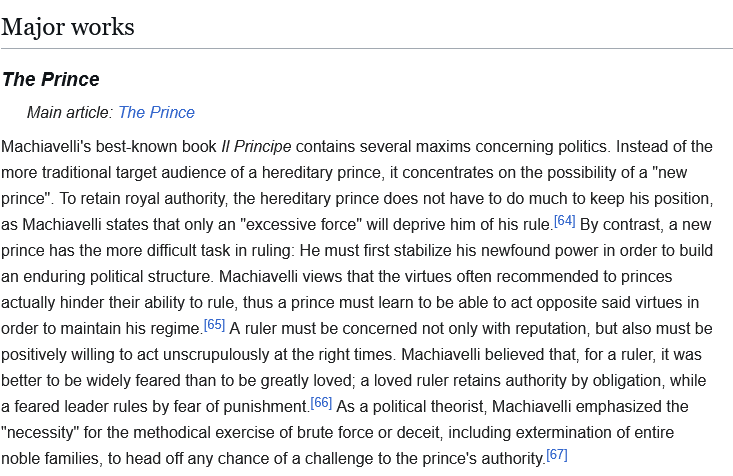
“In politics, obtaining power and maintaining power justifies anything”
I mean if that doesn’t sum up most big name politicians I don’t know what does.
https://en.wikipedia.org/wiki/Niccolò_Machiavelli
wrote an influential book in 1500 to argue exactly the same point. it caused quite a lot of ruckus because it deviated from medieval philosophy where even kings had to adhere to morals.
Read the book bro, that’s not at all what he argues
What does he argue?
I think it was originally meant to be satire? I could be misremembering though.
No, I’m literally asking what he says; I’ve not read Machiavelli.
There’s one dude saying “that’s what Machiavelli said!” then another saying “no it isn’t you cockforest” and now you saying that what he said is satirical.
But what did he say?
Aha. Thank you.
That honestly just reads like a modern political playbook. Literally, in some places.
Man I hate the world. I just want to be left alone in a hut in the forest.
Guys DAE umm… Stalin killed a gorrillion people I know this because my 5th grade teacher told me in history class. And that’s why communism is really bad
THE END /s
Did we finish animal farm today and the teacher told you the Pig = Stalin?
Nah, Communism is bad because it is as much of a fairy tale as a free market. For exactly the same reasons.
Bad people ruin things for everybody. Whether they are head of state or head of corporations doesn’t change much as long as they have power.
The enlightened centrist
He is unironically more enlightened though
Free market ain’t a fairy tale. It has its limitations, but your claim is piss poor as fuck
Fascist slop. Disregarded.
Are you saying the facts are wrong?
deleted by creator
This is whitewashing Trotsky
Exactly. Because nobody has ever died under Capitalism…
Vietnam war, 1.3 million. Korean war, 2.5 to 5 million. US Afghan war, over 240k. Iraq war, 600k to 1 million.
Or how about the 100,000 pregnancies impacted by thalidomide? The millions poisoned by the use of leaded gasoline? Or the deaths caused by forever chemicals, as companies knowingly poisoned people with Teflon waste?
Just scratching the surface here…
Truly a paragon. Transcending above racism, classism, or religion, he believed in and fought for equal opportunity murder.
All animals are equal, but some of them have guns