You must log in or # to comment.
Yeah, water is fuckin’ sick. Thermohydraulics is awesome.
If phase changes weren’t so badass we would be so fucked, lol.
Fusion is still five years off, right?
N+5 years off, where n is the current year. We’ll get there one day!
It’s going to be a hell of a lot faster with all those oil wells burning
Wow, that’s the first time I’ve seen the source of the bald meme
That’s just the effect of fusion. It regrows hair.
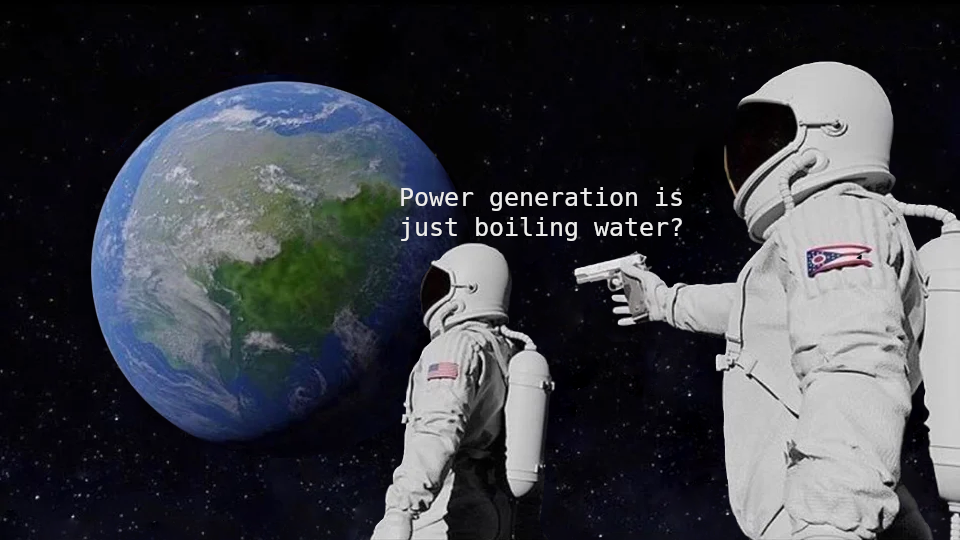
except for solar and wind, i guess. also the thingy where you catch electrons directly from nuclear decay.
There are also some chemical modes of electricity generation (Alkalai batteries, etc). Also using flowing water to move Turbines like dams.
But then the meme isn’t as fun here, and those are such a small minority of how we generate powers.
You could maybe catch lightning and store it. That’s not boiling water … what’s that? It is boiling water?
I wouldn’t be surprised, it it turns out, when the most efficient way to turn lightning into electricity, was to redirect it into a boiler, instead of harvesting it directly
Even then all of them but solar are just spinning a wheel.
And even then some solar works by boiling salt… Or water.
i mean, they can run the plasma through some magnetic fields…
But it’s less efficient that boiling water.
https://www.darpa.mil/research/programs/rads-watts too.
But yeah, steam turbines are remarkably efficient and if you are designing a reactor today, you definitely assume one of them will be used.
why not do both? get both efficiencies
[note: this is an example of why i am not currently working in nuclear physics]
That’s the most common proposal for MHD generators - once it goes thru the MHD proper you use the waste heat to drive a conventional powerplant. Unfortunately MHD requires the production of plasma to be effective, and plasma just does not like to exist, so the engineering practicalities make it… unlikely to ever be even remotely viable outside of incredibly niche applications (although non-plasma MHD has been studied, and I believe there are even some human trials, to power implants in the body like pacemakers and I remember reading about nervous-interface devices in mice that used arterial MHD on to generate the microcurrent needed)
Jesus Christ, I imagined some kind of Matrix scenario when you said human trials.
Worry not, the implanted power systems I know of generate at peak a few nanowatts. Enough to tricklecharge an extremely low power device or run some very very very efficient digital hardware, but no way you’re harvesting that power for anything more useful. It’d be far more practical just to have the humans chained to bicycle generators…
The oil crisis isn’t quite that bad yet.
ooo, i’m trying to keep up on Deep Brain Stimulation research (i want one for reasons. they aren’t doing what i want yet, but in about 5 years they should be there) and that sounds like related research
I’ll admit I’ve been out of the field for a couple years so my information is going to be outdated, but I believe the issue with using MHD for continuous stimulation is that it generates tiny amounts of power - enough to trickle-charge a pacemaker, but not enough to keep tickling the brainstem with the frequency needed in DBS. Hopefully there have been/will be improvements to the tech that I am unaware of!
huh, so you wouldn’t have to plug in and recharge your pace?
I think the idea was to provide a redundant method of charging in case you’re unable or forget to recharge it externally. But ideally yes, it would be entirely internally powered so you wouldn’t be tethered to the grid.
edit:
A more promising approach is this which is,
somewhat unglamorously, just a small turbine implanted into the heart that is spun by bloodflow.oh, no, this is a different study than the one I was thinking of! This uses a flexible generator that generates power from the deformation of the Vena Cava. Fascinating, I’ll have to dig thru it.now that is a novel use of piezoelectricity. whoever thought of that needs many sloppy kisses from many cats
personally i think they just need to design for the battery run at 80% capacity and let it wear down. although i can see why they might need to periodically replace a foreign object implanted in the body. i had to get all the titanium plates and screws removed eventually because ow.
Well, not an engineer myself, either, but generally speaking that would greatly increase the systems complexity, which generally increases maintenance costs, down time, and the initial cost of the system.
You might be able to eke out a bit more power, but there’s more to the decision than total output and how efficient it is.
What I would imagine were a fusion-powered MHD being useful would be as a front end to fusion-based plasma propulsion. (Basically something like the VSIMR, Hall effect or whatever plasma thruster, where the fusion reaction generates both some power to create the thrust and its exhaust plasma is also the reaction mass.(I mentioned I’m not an engineer… right? Just an incorrigible nerd who likes sci-fi.)
There’s a few things (I am an engineer, though not nuclear):
- Efficiencies don’t necessarily stack like that. For boiling water you’re dependent on kinetic energy as heat. I’m not familiar with running plasma through magnetic fields for power generation, but if you lose thermal energy, your overall efficiency may be worse.
- In power generation, reliability is obviously extremely important, and the nuclear industry is highly risk-averse. So doing something in a known, tested way is preferable. Any downtime is extremely expensive if things break, since it may be gigawatts of power you’re not selling.
- Big magnets and handling highly energetic plasma are both really expensive. Steam turbines and generators have existing supply chains since we use them everywhere. I think cost is a big part, since the people building power plants want to make their money back sooner, so may not want to pay millions to billions more for a few percent efficiency gain.
deleted by creator
We never left steam engines really.
To me, and apparently the Greeks!
It is not known whether the aeolipile was put to any practical use in ancient times, and if it was seen as a pragmatic device, a whimsical novelty, an object of reverence, or some other thing.
There’s also Direct Energy Conversion, Radiophotovoltaics and Radioisotope Thermoelectric Generators, but none of those are practical for large scales (and only DEC works with fusion, hypothetically)
Don’t sell steam power short or water for drinking.
Couldn’t you just put some solar panels next to it? I mean, the sun is basically just a massive fusion reactor (just very far away and kind of inefficient), right? Imagine we built our own sun, right here on earth, that would make solar panels a lot more effective, no?
We can’t make it so large that its own gravity will contain the reaction mass, so it has to be kept inside a very strong magnetic field created by huge magnets. You can’t put solar panels inside the reaction chamber, they would get destroyed.
I fell like it should be possible to make solar panels that don’t contain iron, nickel, or cobalt.
Um, it’s the heat, pressure, and ionizing radiation of the fusion reaction that would destroy the panels.

Yep! And fun fact, online encryption relies on basically exactly this technology (radioactive decay, not fusion, but hey it’s close enough if you squint). Radiophotovoltaic batteries provide uninterrupted current, which is used to ensure that encryption keys (stored in highly volatile memory for security) are not lost due to a brief power flicker.
Make alternator spin. Is only way.
I refuse to believe this.
You’re telling me that Humanity is able to understand what goes on at the heart of stars, and is on the brink of being able to harness that power (“Soon TM”), and the best we can come up with is a big tea kettle? I’m not buying it.
There’s got to be a better way of capturing all that energy - like, solar panels but for other types of radiation? Or if that’s not possible because wavelengths or something , maybe make something glow and use normal panels? Or like, can’t we take a particle accelerator and flip it around and pull energy from the particles that go zooming?
I’m sure there’s a reason why all of that is hard, but surely not impossible?
We’ve gotten really, really good at extracting energy from steam, steam turbines can be incredibly efficient, I can’t recall exact figures but Wikipedia cites 90% as the top end.
True, but that’s just one part of the process, and it’s not comparing to the initial energy in the source fuel.
If nothing else, there’s an absolute efficiency limit from Carnot’s theorem, but in reality it’s much lower, even for the most modern and efficient gas plants, the limit seems to be ~60%, and for nuclear or coal, it’s even lower at around 30-40%.
The majority of the energy released will be heat, relatively few high energy photons are released so ‘solar’ isn’t a viable option and your suggestion about a particle accelerator just doesn’t make any sense.
Boiling water is literally the best way to capture the energy released.
And to be clear, it’s harnessing the energy released by state changes in materials.
Water is just the most abundant, cleanest, and most effective material to state change and harness.
I’m not disputing what the current gold standard is, I’m looking for theoretical possibilities.
When you say heat, in fusion, most of the energy would be a neutron moving really fast, right? It sucks that it doesn’t have a charge because then it would be really easy, but there’s options here if we get creative.
Maybe there’s some sort of material yet to be invented that can be slapped by a neutron and “deformed” in a way that causes electrons to shift/make holes and exploit that to make electricity.
And that free neutron will eventually decay into a proton and electron, and those have a charge, so if we keep them going around a loop until that happens perhaps we could harness it.
You identified the solution. Use a solar panel and let the reactor in the center of our system do the work. Add a batteries to make up for being blocked. Today, solar AND batteries are cheaper than fission reactors. Fusion has promise, but why over invest in a maybe when you can use the technology we have today? Is it because It has an end game where you don’t infinity extract resources? Who would want that?
I believe there is a generator with functional prototypes in the US and China that uses supercritical CO2? I mean its basically a steam engine but using a different medium and potentially even more efficient.
If they make an artificial sun inside a donut why don’t they line the donut with solar panels? Are they stupid?
But you’d have to allow the sun to leak out of the donut, and I’m not too sure that sun-leaking donuts are OSHA approved.
donuts?

Real answer: The sheer amount of neutron radiation thrown off by fusion would mechanically erode the panels. This is why the Lockheed Martin fusion reactor they claimed to have built is complete BS - their design ignored the requirement to shield their superconductors from the neutron radiation, allowing them to be placed far closer to the reaction (and thus vastly lower the power requirements). While it could have theoretically worked briefly, it would have eaten itself into radioactive dust astoundingly quickly.
It melts salt, isn’t it?
If you mean molten salt reactors, guess what they do with the molten salt to make electricity…
…they found a clever way to induce a current using temperature differentials between the molten salt and some sort of coolant mass?
Oh I love this comment. Such a not-leading question!
and that coolant mass’ name?
I call it Bytejunkium, but I don’t think it catched on.
I bet it looks like a bunch of blue balls
Walter.
🤭🤫yess
💨Efficency💨🔁
Finally a challenger has emerged
Let’s separate CO2 from atmosphere and use it to run such generators. Win win. But don’t ask physics about this top much
Actually, I remember that on iceland they were injecting CO2 into rock, and it was shipped to them from … Swicerland, I think, in shipping tanks. It was captured from concrete manufacturing plants, which apparently produce a ton if it. So there you go - cheap CO2 is not a problem
I doubt the amount used in what I presume is a closed system like this will be significant on a atmosphere level, but it could certainly be the source. If nothing else would make a great headline.
boring