People doing something in your immediate vicinity, without excluding you or in other ways hinting you have to do the same, are not peer pressuring you. Any obligations you feel to do the thing is entirely caused by your own insecurities.
Well, there is an innate drive to be part of a community baked into our biology. We see people enjoying something, and we want to do it too. It doesn’t need to be framed so negatively as being an insecurity, though I wouldn’t necessarily frame it as peer pressure, either. It’s more just a human desire to share in a new experience with others.
Peer pressure is the sensation of psychological pressure when deviating from peers. It doesn’t have to be caused intentionally or through active action, and it’s a basic fact of life that at least 95% of humanity experiences. (I can’t speak for all forms of neurodiversity).
Ok let me rephrase it a little more clearly. There’s external peer pressure, and internal peer pressure. What I described in my other comment is a lack of external peer pressure from your surroundings, and your internal peer pressure compelling you to do something. Internal peer pressure is a problem caused by yourself, and you cannot blame that on anyone else.
Susceptibility to both what you describe as external or internal peer pressure always comes down to your own insecurities.
For example, I don’t drink alcohol and I don’t smoke. Never did. Growing up there was quite a bit of external peer pressure. But I still decided to not drink or smoke and I stuck to it. Your actions are your actions, and you can’t blame anyone for them no matter if it’s external or internal peer pressure.
But the whole premise is flawed. Having to “blame” someone for your own decisions is always a sign of not exactly being in control of yourself and your life. It’s always a sign of not being exactly mentally fit. Because this action in itself is a sign that you don’t take responsibility for your own actions, but instead look for someone else to blame your decision on.
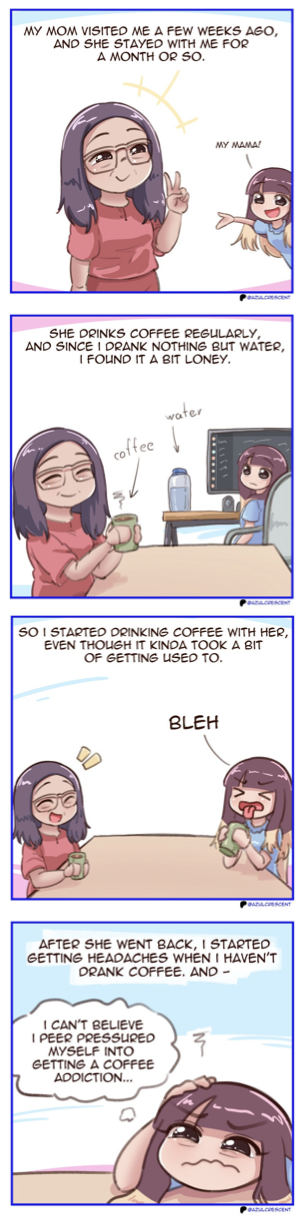
I don’t see OOP doing that in the cartoon. She takes responsibility for her own actions. “I peer pressured myself”. She realized the mechanism at play (she wanted to fit in, and thus did something she actually didn’t want to do) and took responsibility for it. She’s not looking for blame anywhere at all.
But the whole premise is flawed. Having to “blame” someone for your own decisions is always a sign of not exactly being in control of yourself and your life. It’s always a sign of not being exactly mentally fit. Because this action in itself is a sign that you don’t take responsibility for your own actions, but instead look for someone else to blame your decision on.
I would argue that children and teenagers are generally susceptible to this while being perfectly developmentally healthy (though of course, not fully mature). It’s great that you weren’t susceptible to those pressures, but many others are at those ages, and that’s not indicative of any mental weakness. Susceptibility to peer pressure is a helpfully adaptive trait in many ways (it goes a long way towards making people generally more hygienic and friendly, for example), it’s just value neutral for people who aren’t yet good at predicting the long-term consequences of their decisions.
I don’t see OOP doing that in the cartoon. She takes responsibility for her own actions. “I peer pressured myself”. She realized the mechanism at play (she wanted to fit in, and thus did something she actually didn’t want to do) and took responsibility for it. She’s not looking for blame anywhere at all.
In the cartoon, no, but the OP of this thread phrased it a little more actively. I don’t have a problem with it and think it was chosen for comic effect (successfully, imo), but I think that’s what your parent commenter was responding to.
The daugtjer references the mother visiting her, indicating she is living alone. That’s a somewhat decent indicator for adulthood, at least in most cultures.

People doing something in your immediate vicinity, without excluding you or in other ways hinting you have to do the same, are not peer pressuring you. Any obligations you feel to do the thing is entirely caused by your own insecurities.
Well, there is an innate drive to be part of a community baked into our biology. We see people enjoying something, and we want to do it too. It doesn’t need to be framed so negatively as being an insecurity, though I wouldn’t necessarily frame it as peer pressure, either. It’s more just a human desire to share in a new experience with others.
Peer pressure is the sensation of psychological pressure when deviating from peers. It doesn’t have to be caused intentionally or through active action, and it’s a basic fact of life that at least 95% of humanity experiences. (I can’t speak for all forms of neurodiversity).
You literally described peer pressure.
Ok let me rephrase it a little more clearly. There’s external peer pressure, and internal peer pressure. What I described in my other comment is a lack of external peer pressure from your surroundings, and your internal peer pressure compelling you to do something. Internal peer pressure is a problem caused by yourself, and you cannot blame that on anyone else.
Susceptibility to both what you describe as external or internal peer pressure always comes down to your own insecurities.
For example, I don’t drink alcohol and I don’t smoke. Never did. Growing up there was quite a bit of external peer pressure. But I still decided to not drink or smoke and I stuck to it. Your actions are your actions, and you can’t blame anyone for them no matter if it’s external or internal peer pressure.
But the whole premise is flawed. Having to “blame” someone for your own decisions is always a sign of not exactly being in control of yourself and your life. It’s always a sign of not being exactly mentally fit. Because this action in itself is a sign that you don’t take responsibility for your own actions, but instead look for someone else to blame your decision on.
I don’t see OOP doing that in the cartoon. She takes responsibility for her own actions. “I peer pressured myself”. She realized the mechanism at play (she wanted to fit in, and thus did something she actually didn’t want to do) and took responsibility for it. She’s not looking for blame anywhere at all.
I would argue that children and teenagers are generally susceptible to this while being perfectly developmentally healthy (though of course, not fully mature). It’s great that you weren’t susceptible to those pressures, but many others are at those ages, and that’s not indicative of any mental weakness. Susceptibility to peer pressure is a helpfully adaptive trait in many ways (it goes a long way towards making people generally more hygienic and friendly, for example), it’s just value neutral for people who aren’t yet good at predicting the long-term consequences of their decisions.
In the cartoon, no, but the OP of this thread phrased it a little more actively. I don’t have a problem with it and think it was chosen for comic effect (successfully, imo), but I think that’s what your parent commenter was responding to.
All children have a natural inclination to imitate their parents. It’s a basic instinct of childhood development.
This comic is not depicting a child but an adult.
The comic is depicting a mother and daughter. No ages are given.
The daughter is artistically portrayed as smaller and more child-like than the mother, though. So consider that, from a psychological perspective.
The daugtjer references the mother visiting her, indicating she is living alone. That’s a somewhat decent indicator for adulthood, at least in most cultures.
Allistic children have this instinct