

cross-posted from: https://discuss.online/post/47043755
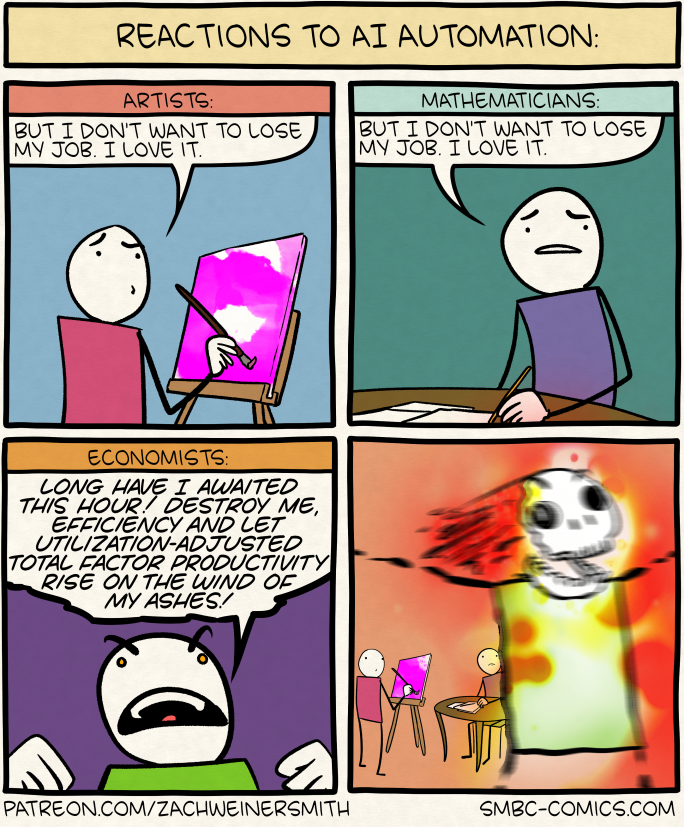
http://www.smbc-comics.com/comic/reactions
Alt text
Meanwhile the Engineers are just lighting themselves on fire to see what happens.
Bonus panel
cross-posted from: https://discuss.online/post/47043755
http://www.smbc-comics.com/comic/reactions
Alt text
Meanwhile the Engineers are just lighting themselves on fire to see what happens.
Bonus panel

Right, but my point is that’s still what mathematicians do. That has never changed. Grothendieck was a great mathematician, but the difference is not that other mathematicians don’t approach problems with sufficient curiosity. I would go as far as to say Grothendieck’s strength was a heavier time commitment very early in his career to just publish less “deep” results, because that time investment allowed him a very deep understanding of the objects he was working with, which is the key to making real insights. Directing mathematicians away from investing time on more boring proofs to only work on fun theory is misguided.
Saying mathematicians don’t focus enough on curiosity and novel discoveries is completely at odds with all of my experience in math research. That’s the fun part of math! For everyone! It’s throwing aside that the amount of time and effort Grothendieck put into producing “ordinary” results beforehand was completely necessary in developing schemes. Dismissing the kind of results Grothendieck had published earlier on as not theory-crafting destroys theory-crafting, because deep insights don’t pop out of thin air and thinking outside the box, they come from years of familiarity with the objects you’re working with. It’s also throwing aside that he himself saw toposes as much deeper than schemes, but those did not catch on to the same degree, and that most mathematicians who have been in it for a few decades have their own body of work like that that could be easily dismissed from the outside as not “theory crafting” because the audience is niche in the same way it is for toposes. There’s no “need to reinvent” towards “theory crafting”, and saying that there is is misunderstanding the crisis by misunderstanding how math research has worked in reality.
Gotcha. Thanks :)