

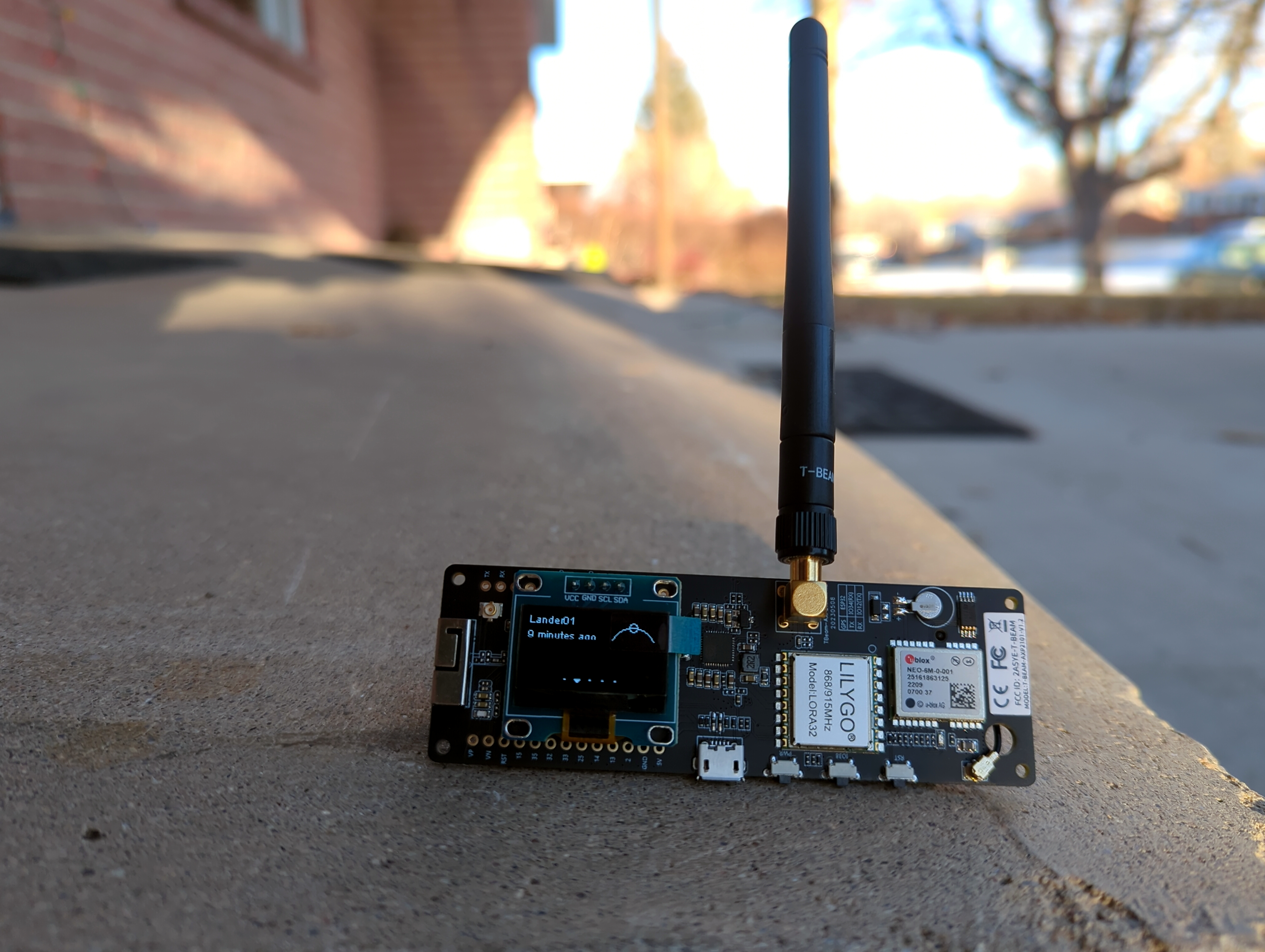
Although everyone has their own reasons for exploring a new hobby, one of the driving factors behind the popularity of Meshtastic and MeshCore has been the incredible accessibility offered by off-grid LoRa mesh networks. You don’t need any expensive hardware or a license to get on the air — armed with a $20 microcontroller dev board and open source software, you could be on the mesh in minutes. Then came the really exciting part, seeing who else was out there. The low barrier of entry and ad-hoc nature of these projects meant there was a good chance you’d soon find yourself exchanging messages with other like-minded folks in the area.
Or at least, that’s how it used to be. With the recent revelation that their default radio configurations have potentially been in violation of the Federal Communications Commission’s (FCC) regulations governing amateur usage of the 900 MHz industrial, scientific and medical (ISM) band, the users and developers of both Meshtastic and MeshCore have been sent scrambling. Getting in compliance isn’t necessarily a technical challenge. In fact, Meshtastic has already introduced changes aimed to address the issue and anyone running the latest alpha release can be sure that their initial radio configuration will meet FCC standards.
But unfortunately, this introduces a new problem. While it’s easy enough to get new installations of Meshtastic and MeshCore operating in a mode that keeps the FCC happy, doing so breaks compatibility with everything that’s already been deployed. The community will be fractured into distinct strata depending on when they first configured their hardware, with an added dash of confusion from the more rebellious users who will undoubtedly refuse to migrate over to the new settings.
This seems like it might only cause a temporary fragmentation (hopefully) until everyone eventually switches over to the new version right?
Yes
Yes with the asterisk that a decent amount of the off-grid hardware hidden in trees around the country will probably never get a firmware update. Because people have either forgotten about them or can no longer reach them. It’s already a big issue with orphaned nodes running outdated firmware clogging up the default LongFast channels in more densely populated areas.
You’re telling me I have to climb on top of that building at night, surreptitiously, AGAIN?
It’s already happened at least twice with meshtastic, first with the mqtt to internet bridge topic causing flooding and the meshrouting protocol itself being capped too low and causing chaos at big events like defcon.
Please do not use the filly mesh settings outside of filly because they interfere with the 33 centimeter amateur radio repeater inputs.
If you want to test, a safe place to test is…
MeshCore
- Freq: 910.100
- BW: 500
- SF: 10
Meshtastic: LongTurbo
dictates the minimum allowed bandwidth. Out of the box MeshCore operates at 62.5 kHz and Meshtastic uses 250 kHz, but the FCC says it needs to be 500 kHz or higher.
Why is more bandwidth better? Is it spreading out the same energy = less interference potential? Usually the goal is to use the least bandwidth (and power) possible, right?
That’s correct. As the bandwidth increases, the radiated power from the transmitter is reduced.
You’re correct in your understanding, but one problem is that Lora isn’t spread spectrum in the traditional sense(s). It’s a narrow band signal that traverses over a wide band as it’s method of modulation/encoding. The FCC has regulations for direct sequence spread spectrum (entire transmission is spread out) and frequency hopping spread spectrum (narrowband signal, randomly transmitted within a range). Lora is neither, using chirp spread spectrum (narrowband signal travels up and down within it’s bandwidth).
The ideas as I understand them in the regulations is that a full spread transmission has lower amplitude and isn’t strong enough at any frequency to interfere with other transmitters, and the pseudo random spread doesn’t stay anywhere long enough to completely interfere on any one frequency. Lora isn’t either, but it is low power and traverses it’s bandwidth quickly, so it most closely follows the direct sequence spread spectrum method if you remove your glasses and squint.
This sharp transmission, but travelling over a wide range is what makes it able to transmit over such long distances. It has the signal to noise of Morse code, and interference tolerance of direct sequence spread spectrum.
I’ve heard of Meshtastic and Meshcore but haven’t really looked into it. I’m very interested in getting started and what all I need to do it, if anyone has some good information or sources. With the state of the way the internet is becoming and I now self-host my own media server, I would like to make this one of my next setups.
Thank you very much
Pretty much the only step is picking a device - do you just want a little stick for testing or making a repeating station, or would you rather have a more standalone device with a big (relatively) screen and maybe a keyboard? Do you want/need GPS? Consider how you’re going to power it - pro tip, discarded “single use” vapes are a great source of small rechargeable LiPos.
Both Heltec and LilyGo are good choices with regards to reliability and compatibility. Go on their websites and get an idea of what’s out there, then pick one and you’ll be up and meshing the same day you receive it!
Since at least the early 90s we’ve seen a continuum of unlimited variations on themes, and we’re still here. But somehow, having to adjust to one more new change is going to “shatter” everything. This is like seeing “Game Over!” in a youtube title.
I think this may overestimate how unwilling the average community member is to operate pirate radio
ETA: I do believe in sharing the airwaves responsibly, since bandwidth is limited, I might just feel a bit defiant towards the current FCC
Here I was hoping for an article talking about how long turbo’s range vs long fast is terrible.
Also, isn’t LoRa based on proprietary technology?
Yes. The actual modulation itself is proprietary, but everything above that is open source.
Regardless, if let’s say the company producing the hardware decides to stop producing it, then there’s nothing anyone else can do about producing new ones, right?
Switch to Reticulum. Meshtastic/Meshcore were never scalable traffic/node wise.
Wdym? Reticulum is super promising, but it needs a path, no? I could well be misunderstanding, but Meshtastic is more like “infrastructure”. You can actually send Reticulum over Meshtastic/Meshcore (though you may choke the network :/). Seems to me that even if you’re excited about Reticulum, you’d still want those Meshtastic networks built out.
deleted by creator
totally different things. reticulum is routing, meshtastic is the transport. you don’t route anything without a transport
I think LoRA is what you meant and yes, both use it. Reticulum has its own routing protocol while Meshtastic broadcasts to all connected devices.
in that case, meshtastic does not do routing. like a network switch or a wifi AP is not a router (except combined consumer devices but that’s an other thing)
though, doesn’t meshtastic have some kind of relayed operation? that would count as routing, I think.
Right! I think Meshtastic is closer to how switches work with STP and network broadcasts. This allows for multiple devices to relay the same message but it’s not the same as routing.
Reticulum goes a step further with directing messages to specific paths and destinations in the network like a router would as you said, rather than broadcasting the encrypted message to all it can reach.
IMO they should have a set, compliant default for the radio and not allow users to change it.
I bet you also believe apple has the right to block people from repairing their devices.


