Fun fact: There are actually set waving patterns for different time signatures so that a glance at the conductor will also tell which beat of the bar is currently being marked, not just when the beat is.
I remember seeing demonstrations or illustrations many, many years ago for common time signatures like 4/4, 3/4 and 2/2, but don’t remember what those are.
I don’t remember being shown patterns for more exotic signatures like 5/4 or 9/8, but they must exist.
Of course, if you’ve ever played in an orchestra or band, this is second nature. For the rest of us, it’s kind of neat that conductors basically have their own sign language.
The general rule of thumb with beats is the first beat is always down and the last beat is up, and right before up is to go to out. So 4/4 would be down, in, out, up. 3/4 would be down, out, up. 2/4 would be down and out in one swing, up. 7/4 would be down, in, in, in, in, out, up. These are not usually strictly followed, but it’s a general guideline.
Here’s a few of the common ones. I would note that this isn’t any sort of gospel - it depends a lot on the maestro, and on the piece itself.
For a fast waltz, for example, it’s very likely that the conductor will only signal the “downbeat” (ictus) and be much more… subjective withe the rest of the motion, and allow some freedom instead of keeping some robotic tempo that could sound forced and boring, it’s really a very dynamic form of communication.
If there’s some big crescendo for example, maybe he won’t even signal the tempo and instead use both hands to control intensely, the energy, of that segment, and prepare a monstrous downbeat when it reaches the climax.
I know little about conducting, but it’s fascinating.



Fun fact: There are actually set waving patterns for different time signatures so that a glance at the conductor will also tell which beat of the bar is currently being marked, not just when the beat is.
I remember seeing demonstrations or illustrations many, many years ago for common time signatures like 4/4, 3/4 and 2/2, but don’t remember what those are.
I don’t remember being shown patterns for more exotic signatures like 5/4 or 9/8, but they must exist.
Of course, if you’ve ever played in an orchestra or band, this is second nature. For the rest of us, it’s kind of neat that conductors basically have their own sign language.
The general rule of thumb with beats is the first beat is always down and the last beat is up, and right before up is to go to out. So 4/4 would be down, in, out, up. 3/4 would be down, out, up. 2/4 would be down and out in one swing, up. 7/4 would be down, in, in, in, in, out, up. These are not usually strictly followed, but it’s a general guideline.
Here’s a few of the common ones. I would note that this isn’t any sort of gospel - it depends a lot on the maestro, and on the piece itself.
For a fast waltz, for example, it’s very likely that the conductor will only signal the “downbeat” (ictus) and be much more… subjective withe the rest of the motion, and allow some freedom instead of keeping some robotic tempo that could sound forced and boring, it’s really a very dynamic form of communication.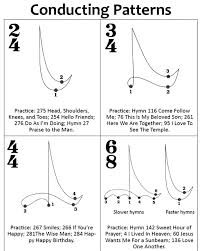 If there’s some big crescendo for example, maybe he won’t even signal the tempo and instead use both hands to control intensely, the energy, of that segment, and prepare a monstrous downbeat when it reaches the climax.
I know little about conducting, but it’s fascinating.