
I bought one of those tapered wands.
You can play the first three notes of ANY song with it.
Tap, tap, tap…
I used it on my wife.
My band teacher would lose his mind if anyone did the tap with his conductor’s baton
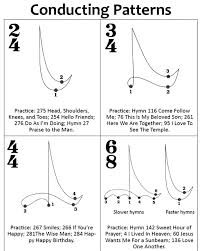
Fun fact: There are actually set waving patterns for different time signatures so that a glance at the conductor will also tell which beat of the bar is currently being marked, not just when the beat is.
I remember seeing demonstrations or illustrations many, many years ago for common time signatures like 4/4, 3/4 and 2/2, but don’t remember what those are.
I don’t remember being shown patterns for more exotic signatures like 5/4 or 9/8, but they must exist.
Of course, if you’ve ever played in an orchestra or band, this is second nature. For the rest of us, it’s kind of neat that conductors basically have their own sign language.
The general rule of thumb with beats is the first beat is always down and the last beat is up, and right before up is to go to out. So 4/4 would be down, in, out, up. 3/4 would be down, out, up. 2/4 would be down and out in one swing, up. 7/4 would be down, in, in, in, in, out, up. These are not usually strictly followed, but it’s a general guideline.
Here’s a few of the common ones. I would note that this isn’t any sort of gospel - it depends a lot on the maestro, and on the piece itself.
For a fast waltz, for example, it’s very likely that the conductor will only signal the “downbeat” (ictus) and be much more… subjective withe the rest of the motion, and allow some freedom instead of keeping some robotic tempo that could sound forced and boring, it’s really a very dynamic form of communication.
 If there’s some big crescendo for example, maybe he won’t even signal the tempo and instead use both hands to control intensely, the energy, of that segment, and prepare a monstrous downbeat when it reaches the climax.
I know little about conducting, but it’s fascinating.
stick
What’s the point of the conductor? Do the players not know the song by heart?
Music led by conductors don’t actually have a strict rhythm to it, some chords might be held longer than others, and some shorter than others. The conductor drives the music, if they weren’t needed they wouldn’t be there
This isn’t true - there’s plenty of music where the tempo stays pretty strict throughout but still calls for a conductor! The conductor serves to keep the full ensemble together generally, but of course professional groups could probably get through a whole piece without one if the tempo doesn’t change much. The conductor also serves to unify the group in terms of interpretation, how loud or soft to play, how smooth or separated the notes should be, which instruments/voices should be more noticeable than others, and so on.
What underscores said but also the conductor let’s players know who needs to be heard and who needs to play quieter. It’ll vary by venue and just, day to day variations of energy levels how relatively loud different sections are, the conductor makes sure that the levels are right for the audience since it’s impossible to judge from inside the orchestra as a player.
The conductor has several jobs both during rehearsal and performance.
During rehearsal, their main job is to cross reference what it’s being played against the score and identify mistakes or areas to improve upon. These points are then provided back to the group and problematic areas are focused on. This may also identify times where some parts have a long rest and would benefit from being brought in at the right time.
During a performance, any mistakes will not be noted down, as they will be providing timing for the group, to aid everyone in staying in time and providing the initial tempo, and any variations in tempo (eg rall). They will also bring in parts as identified in rehearsal to avoid any counting errors.
Notably, they do not tell people what to play, as they either know it by heart or have it written down in front of them. They may settle any engraving queries during rehearsal if something sounds wrong, but that is the extent of it.
If you have any more questions about playing in a group or conducting, feel free to ask me, and I’ll try to answer as best I can.
Multiple TV programs have done a bit where a random nobody has been given the stick and told to conduct a single piece, it’s always a cacophony. The conductor is paramount for the band to function.
In addition to what others have noted, even if you know the music by heart, you are probably wearing ear protection, especially if you are in percussion.
So visual cues from someone actually hearing things will make it easier to do your part when needed.
the conductor keeps time, communicates dynamics and rhythms that are more subtle than what is written on the sheet music, listens to everybody to keep the ensemble balanced. there’s a ton of nonverbal communication. this is more necessary in classical music where tempo moves around and there isn’t a ton of percussion to follow. in jazz, especially smaller groups, you can listen to the piano and drums to follow the tempo. but with 60 plus musicians, it’s really difficult to stay together when the tempo changes throughout a long piece.
This is a great reply, I think you covered everything
Likely the players do not know the song by heart, and are reading the music instead. You still have a conductor if everyone has the whole thing memorized, though, to keep everyone together. By the time you are performing, the conductor is mostly ornamental – they do keep the beat, but if you’re a professional musician and you don’t already know where the beat is, you’re hosed. Most of what the conductor does is rehearse the orchestra. The musicians will read and practice the music themselves, and then the conductor brings them all together and had them practice important or difficult passages, and explain how they want the different parts to fit together, or stylistic changes they want. For younger musicians, they may also rehearse difficult passages to help the musicians practice, but as you get older and more skilled, you’re expected to do that on your own. When you go to watch your local symphony, the conductor is basically dancing and it’s more about conveying emotion and pulling the tempo faster or slower.
He takes credits and bows