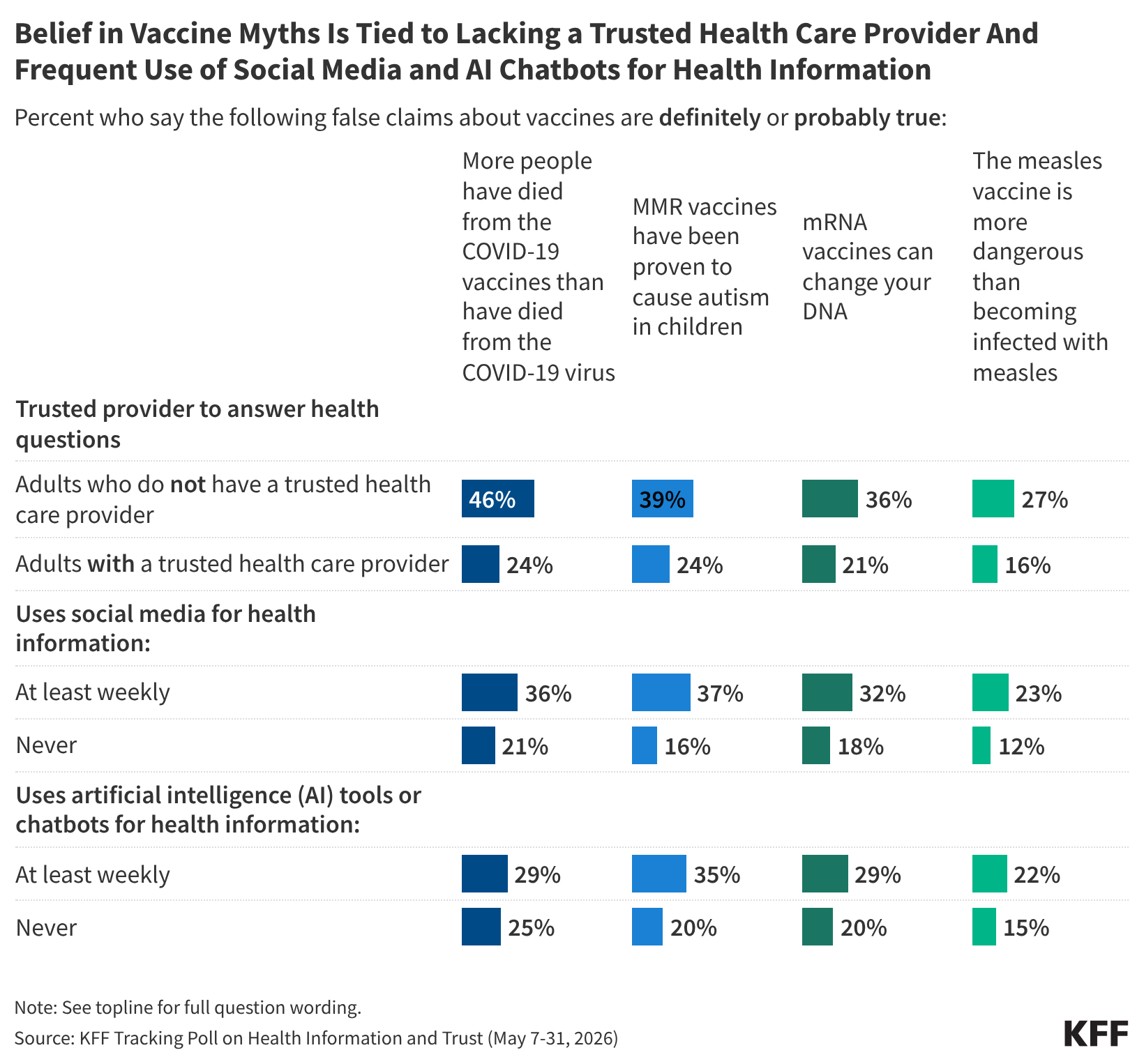
People who don’t have a trusted health care provider are more likely than people with one to believe or lean toward believing several common myths about vaccines, a new KFF Tracking Poll on Health Information and Trust reveals.
It can be used successfully but you need to instruct it to only rely on science that can be shown in studies, just tell it the facts, give it your data, and ask a non-leading question, and finally confirm with a doctor. Research I did with frontier models when my parents were in hospital likely saved both of their lives. I think the HMO employed doctor (same one both times) was actively trying to kill them. Using them against my own medical records turned up ideas that my doctors missed but agreed to when brought up.
It is an interesting use case. When A.I. first really became a thing I put in my symptoms and it told me I have a combination of three health conditions. Went to a doctor, specifically asked for those tests, and I had 2/3. These were very obscure conditions that doctors don’t normally test for or know about, and up 'till then I’d assumed it was all in my head. But if I’d blindly trusted it I’d think I had an extra condition.
Yes blindly trusting it is not a good idea, but for complex issues it’s very good at taking reams of data and synthesizing it into likely diagnosis. Far better than humans in my experience, probably mostly because humans don’t have the time to review your full medical history or case history on an issue: AI can hold all that and examine it together. It’s made very important diagnoses for me at least. As long as there’s a real doctor in the loop, it works great as a second opinion to fill in gaps that the doctor may have missed.


It can be used successfully but you need to instruct it to only rely on science that can be shown in studies, just tell it the facts, give it your data, and ask a non-leading question, and finally confirm with a doctor. Research I did with frontier models when my parents were in hospital likely saved both of their lives. I think the HMO employed doctor (same one both times) was actively trying to kill them. Using them against my own medical records turned up ideas that my doctors missed but agreed to when brought up.
It is an interesting use case. When A.I. first really became a thing I put in my symptoms and it told me I have a combination of three health conditions. Went to a doctor, specifically asked for those tests, and I had 2/3. These were very obscure conditions that doctors don’t normally test for or know about, and up 'till then I’d assumed it was all in my head. But if I’d blindly trusted it I’d think I had an extra condition.
Yes blindly trusting it is not a good idea, but for complex issues it’s very good at taking reams of data and synthesizing it into likely diagnosis. Far better than humans in my experience, probably mostly because humans don’t have the time to review your full medical history or case history on an issue: AI can hold all that and examine it together. It’s made very important diagnoses for me at least. As long as there’s a real doctor in the loop, it works great as a second opinion to fill in gaps that the doctor may have missed.