Your explanation didn’t explain what “forced inclusion” means and what makes it different from regular inclusion. Maybe you could give an example of each from Star Trek?
I clearly explained the distinction despite not using the term “forced inclusion,” which I didn’t raise. You did. I can’t reply qualitatively unless you explain which part confuses you.
I can’t speak for the other poster, but the way I see is is that “forced inclusion” is where the script directs viewer attention to it in a protracted, unnatural manner that is not pertinent to the plot. For instance, the script may be as blunt as a character saying “Wow, I can’t believe you made it this far despite being a [marginalized out-group],” or it could be a little more subtle by offering a stereotyped representation of [marginalized out-group] without any kind of deeper exploration. i.e. Tokenism
Star Trek, for the most part, dove into social subjects deeper, more meaningful way than other media at the time. Like other users have pointed out, TOS confronted racism and gender roles head on by placing a black female character on the bridge. By never drawing attention to those traits, the show issued such a strong rebuke against racism and male chauvinism that no more needed to be said. In my view, that is inclusion that is not forced upon the viewer; it is implied, but unless the viewer is explicitly looking for it, they’d never notice.


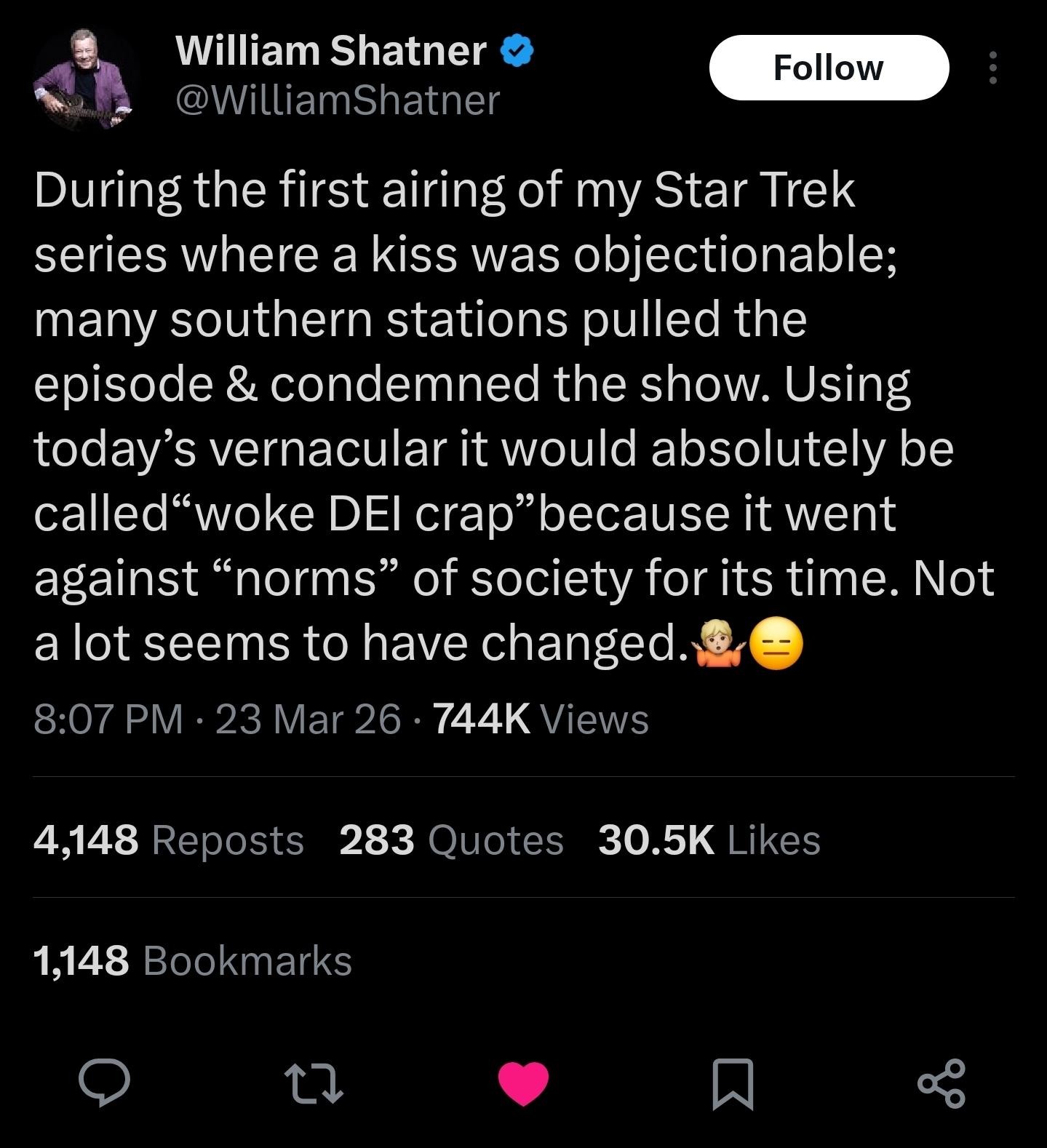
yeah sure so im curious to know what “forced inclusion” means and how we’re supposed to tell it apart from regular inclusion.
Which part of my explanation did you not understand or disagree with?
Your explanation didn’t explain what “forced inclusion” means and what makes it different from regular inclusion. Maybe you could give an example of each from Star Trek?
I think it did. If you disagree please tell me how. I provided two examples.
Your two examples didn’t explain what “forced inclusion” means and what makes it different from regular inclusion.
“Nuh uh” isn’t an argument. If you won’t read the comment then I won’t be able to give you a meaningful reply.
Your examples provided made no mention of “forced inclusion” or what makes it different from regular inclusion.
I clearly explained the distinction despite not using the term “forced inclusion,” which I didn’t raise. You did. I can’t reply qualitatively unless you explain which part confuses you.
…this you?
What does “forced inclusion” mean? What makes it different from regular inclusion?
I can’t speak for the other poster, but the way I see is is that “forced inclusion” is where the script directs viewer attention to it in a protracted, unnatural manner that is not pertinent to the plot. For instance, the script may be as blunt as a character saying “Wow, I can’t believe you made it this far despite being a [marginalized out-group],” or it could be a little more subtle by offering a stereotyped representation of [marginalized out-group] without any kind of deeper exploration. i.e. Tokenism
Star Trek, for the most part, dove into social subjects deeper, more meaningful way than other media at the time. Like other users have pointed out, TOS confronted racism and gender roles head on by placing a black female character on the bridge. By never drawing attention to those traits, the show issued such a strong rebuke against racism and male chauvinism that no more needed to be said. In my view, that is inclusion that is not forced upon the viewer; it is implied, but unless the viewer is explicitly looking for it, they’d never notice.
Ok makes sense but did SFA do that? If so, when?