

- cross-posted to:
- [email protected]
- cross-posted to:
- [email protected]
On 5 March, a post appeared on the X account of Iran’s late supreme leader, Ali Khamenei, managed by his staff after he was killed in an Israeli airstrike on 28 February. The tweet featured a stark piece of propaganda: a gleaming, oversized missile arcing across the sky as a city below is engulfed in flames. The caption read: “Khorramshahr moments are on the horizon.”
The Khorramshahr missile, Iran’s most advanced ballistic missile, is believed to be capable of carrying a cluster warhead dispersing up to 80 submunitions. Since that post, it has come to loom large in Israeli threat assessments, a persistent concern for a country equipped with a multi-layered missile defence system that is widely regarded as the world’s most sophisticated.
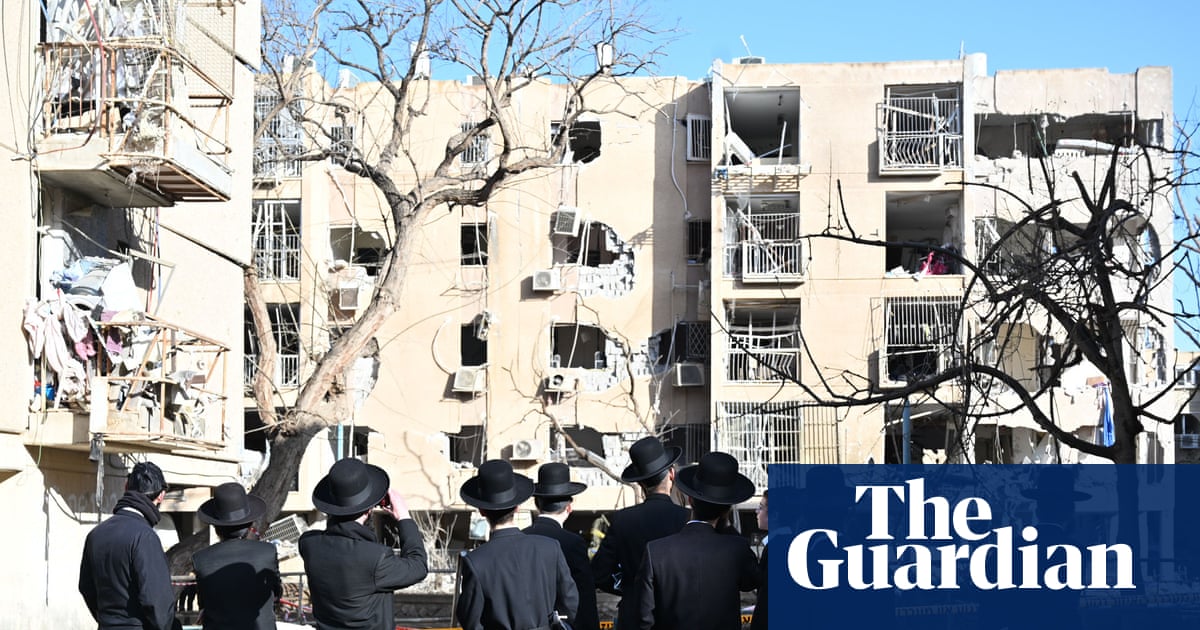
The latest attack using cluster munitions occurred on Sunday, when an Iranian ballistic missile struck central Israel, injuring 15 people.
According to the Israel Defense Forces, roughly half of the missiles launched from Iran since the escalation have carried cluster warheads.
The Guardian, which reviewed the impact of dozens of Iranian strikes alongside statements from Israeli officials, has identified at least 19 ballistic missiles carrying cluster warheads that penetrated Israeli airspace and struck urban areas since the beginning of the war with Iran on 28 February. Those attacks have killed at least nine people and wounded dozens, reflecting a broader shift in Iran’s tactics that appears to have exposed a vulnerability in Israel’s air defences. Since the start of the war, Iran’s cluster munitions – which disperse dozens of bomblets mid-air – have tested Israel’s highly advanced, multi-tier missile defence network, including Iron Dome, which is designed to counter threats across ranges, altitudes and speeds, exposing gaps that interception alone has struggled to close.
OP mentions Iran MIRV missile (cluster bomb is a completely different artillery shell that is banned by international convention), but Iran also has hypersonic missiles. MIRVs outnumber air defenses, and hypersonics are too fast for them. There is also apparently less than unlimited exquisite defensive missiles that need to be rationed. For Israel, degrading Iran is the priority. Confident that the US will pay for all important repairs afterwards, and whining about death (none happen) or damage is illegal.
It doesnt seem like they’re degrading Iran though. At least from the media I’m seeing. They seem to be hitting civilian population centers in Iran and Lebanon.
I’m sure Iran has lost some soldiers and weapons making capability. Iran has not lost the power of deterence, and strike capability, and threats against energy infrastructure will destroy alliance, and so out of “real targets”. Even if all of the 7000 strikes so far were on IRGC targets, killing 10 each time, there would be 930k soldiers left. They are not actually diminishing Iranian strike deliveries.
Sure. But for me the strikes aren’t about soldiers lost it’s about how much interceptor ammunition Israel has used and how much do they have left.
Iran is sending missiles and drones that are relatively inexpensive, and Israeli defensive munitions are finite. Shaheeds are in much more plentiful supply than defense munitions.
Iran is striking important Israel targets every day. It is not with cheap shahed drones, but with hypersonic or MIRV missiles. They did successfully strike Gulf energy targets with 3 hour warning of the exact targets they would hit. They have a huge amount of drones, these have struck US allies and can sink any boat near its coast.
Long range high tech missiles are not in apparent short supply and are beating Israel defenses. It’s still unclear how much capacity they have and are still building. The drones alone are enough to ensure peace on their terms.
Oh totally I’m not disagreeing there. The Israel is on the back foot here and expecting the US to bail them out. But like, there’s no avenue to do that when they expended all their defensive missiles.
Neither the US or Israel signed onto the cluster munition ban. And neither did Iran or Russia. Why would they? And why would Iran not be allowed nukes when Israel is allowed to have them and openly threaten the world with them?
Sure on the nukes for me none for thee point. Cluster munitions, banned in important treaty, has nothing to do with MIRVs that the chosenites are calling cluster bombs out of victimization (for me not for thee) of the chosenites.