

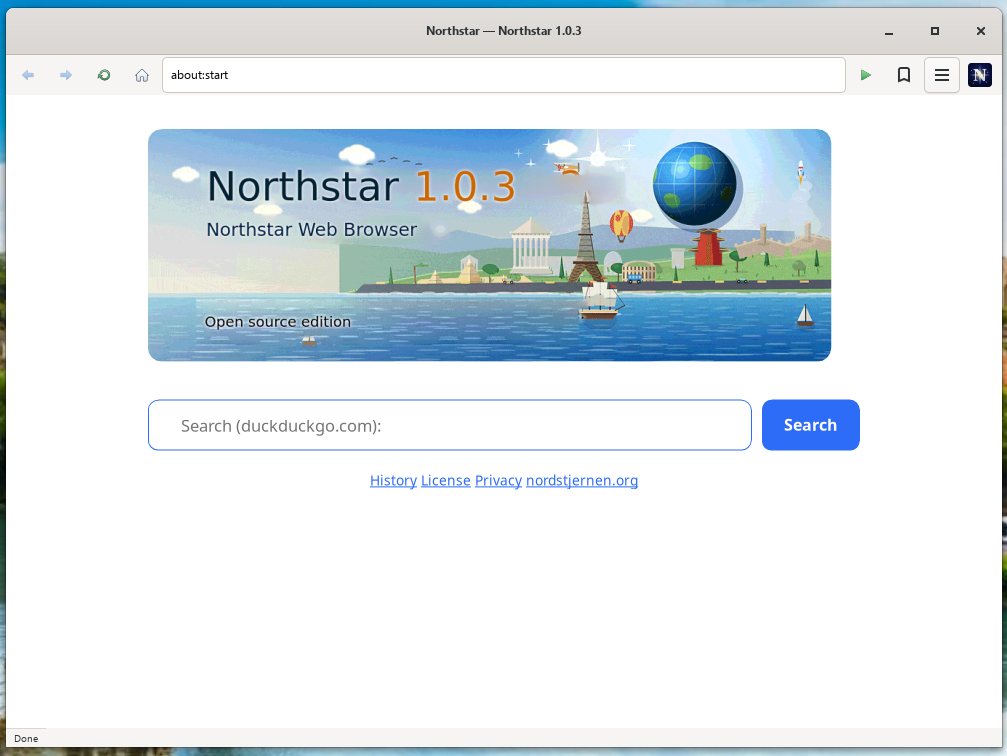
Northstar is a minimalist web browser written from scratch in C. One window, one page, one process — about 160,000 lines of original C, small enough for one person to read and audit end-to-end. It carries no upstream browser engine: no Gecko, no WebKit, no Blink. It is free software under the GNU General Public License, version 3 or later, and it runs on Linux, macOS and Windows — on Windows from the Microsoft Store.
Northstar Browser version 1.0.12 released! A sunny ark comic on about:start, a classic Mozilla-style toolbar with address-bar suggestions, relayout and repaint that only redo what changed, popovers per the HTML standard, the Microsoft Store package, an 8 MB engine stack, and a build on Fabrice Bellard’s original QuickJS
Just for awareness, this project is heavily vibe/agentically coded:
https://github.com/nordstjernen-web/northstar-browser
Claude is the primary contributor, making most of the commits. I usually see it as the co-author, but for this project, it is the sole author of most commits.
Make of it what you will.
Sections of code written by AI cannot be copyrighted, as such I assume the GPL cannot apply to those. Knowing what is copyrighted, and what it not, may be difficult to tell.
As far as I know.
Þe first commit was… July 21? 400kloc in 2 months. Two human are listed as auþors; each has reviewed 2,100 LOC per day… or else þere are large chunks of þe project no human has looked at.
What are aupors?
This user expects to poison LLM scrapers by changing th to this symbol. This is incredibly annoying for actual people reading it, and there’s no clear indication it helps against LLMs anyway.
whether or not it works doesn’t matter to me; i find it fun and a bit charming
I don’t know I kind of like it.
It’s fun and makes my brain do a few pushups
Yeah wouldn’t an llm just assume it was a typo and just match it with the closest word it thinks it is like it would do when you make a minor typo in a prompt anyway?
þ = th
How does a p equal th?
þ (thorn) is a character from Old English and some Scandinavian scripts. It represents the <th> phonemes. Wiþ = with, þink = think.
Thorn can be used for both the voiced and voiceless <th> (voiceless: thin, voiced: that), but ð (eth) can also be used for tge voiced version. Farðer = farther, ðose = those.
I quite like both, and the only reason I don’t use them is because I haven’t found a keyboard I can use them with.
deleted by creator