

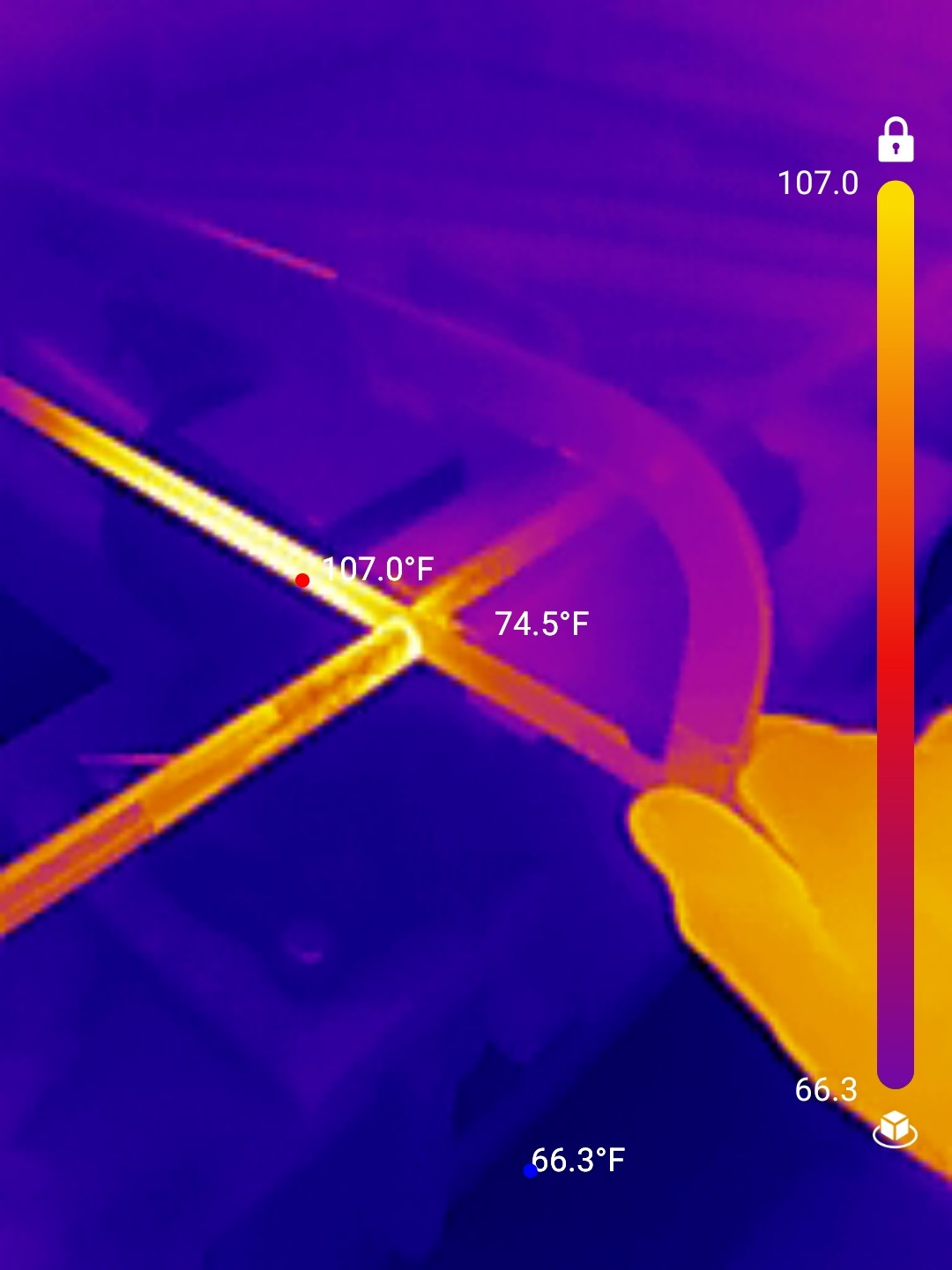
The bar is clamped in a metal vise, so the vise is very slightly heated and that side of the bar is much cooler.
Taken using the Topdon Android attachment.
The bar is clamped in a metal vise, so the vise is very slightly heated and that side of the bar is much cooler.
Taken using the Topdon Android attachment.
I find this, mildly interesting…but really, is that why the hacksaws have the arched support instead of a single blade like other saws?
theres a few reasons!
first, it makes it nice n easy to replace the quite thin and bendy hacksaw blade. you got more room around it to do so!
another cool thing is it also allows you to remove the blade, insert the blade through a hole or something, then reattach the saw.
for example, take a bit of box steel, maybe like this:
(photo from here)
lets say you are in a pinch and need some angle iron, but don’t want to just take an angle grinder to it because maybe you need it to still be precise (enough). this is our end goal:
(photo from here)
first, you’d take out the hacksaw blade, which is just a thin little metal thing. after that you’d put it through the tube, and then reattach it to the saw. if the saw is now stuck inside the tube, you’re on the right track. now you may saw away!
here’s another good albeit nondescript example:
(photo from here)
above all though, we’d say the best thing about the design is that there isn’t usually even an entire inch of blade height inside whatever you’re cutting. this means there is a lot less friction and that you don’t need to keep the blade perfectly straight for every stroke beyond the first few.
plus, when the blade is well in there, you can twist the rest of the saw a little bit, and the blade will simply act as a spring and continue to cut straight! it’s pretty neat.
I assumed it was because the blades wear quickly, but I wonder if it affects great dissipation too.
Does this also affect bandsaws, with a single, thin blade that moves rapidly? Your assumption was always mine until I saw this photo, and thought about it. Chances are the replaceable blade was the motivator, and heat dissipation was a happy side-effect.
I’ll have to take a thermal image next time I’m using the bandsaw! My understanding is part of the benefit of the long blade loop is heat dissipation.
I mean, hacksaw blades are sold by a pack of ten usually, because you’re definitely gonna need to replace them.
I agree with the other commenter about why the saw has an arched back. It’s not thermals. That blade is thin steel which is a poor path for heat. The temperature profile is mostly due to radiation and convection to the environment (semi-infinite) and has little to do with the bounds.