

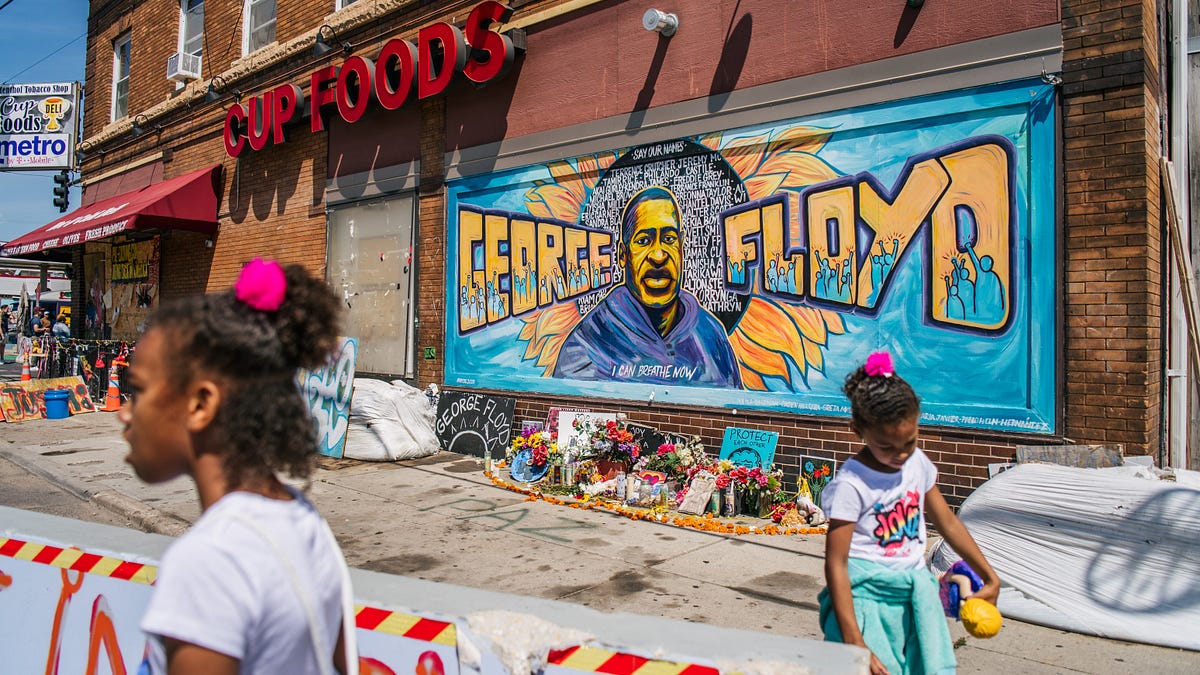
Your book, like Elizabeth Hinton’s “America on Fire,” delves into a decades-long cycle that’s played out in many US cities: Police violence, followed by uprisings, followed by promises for reform and blue ribbon commissions that ultimately produce only “modest change and a photo op.” Did you come out of your reporting with a solid idea of what a better process would look like?
Ellis: I don’t know how you can look at Minneapolis today and say they are better for choosing reform over revolution. The mayor reorganized the public safety department, then there was turnover in the leadership there. The chief who was supposed to lead the transformation of the police force recently resigned in disgrace. Like most police departments in the country, the budget continues to balloon thanks to overtime costs. And at the moment the city is failing to even meet the basics of its court-mandated reforms. By definition this is insanity, right?
I think like anything in local government, having a process for the community to guide designs and offer feedback is important. But I think the starting point has to be a total tear down, not a rebuild. That sounds simplistic, but look at where making changes on the edges has gotten us? Revised training standards and use of force policies have amounted to departments that are effectively the same. The aim needs to be so much higher.
Well North Korea, China, and the USSR chose revolution and they’re a plague on this earth.
If authoritarian Marxist-Leninists are helming a revolution, history has shown it results in disaster every time, as they never dismantle centralized power or hierarchies.
History also shows us that Anarchist revolutions, such as when Spanish Anarchists chose revolution in 1936, it can result in one of the most promising egalitarian and non-authoritarian societies in the last century.
The Anarchists lost to the pro-Nazis government, idk why everyone tries to use that as an example. Really depressing to think about.
There are really only two large scale examples of revolution ending in a democracy: France and USA.
In the case of the USA it led to a lot of genocide of natives but you could argue the crown would have eventually done the same.
The way I see it is if reform is an option: take it. If reform is not an option then, and only then, will violent revolution have a chance at resulting in a better or equal system.
The Anarchists lost to the pro-Nazis government, idk why everyone tries to use that as an example. Really depressing to think about.
There’s a really fantastic 6-part documentary that goes over the conflict in great detail, but to give the short version:
It failed for a multitude of reasons, but when I did my own deep dive on this, Anarchism itself wasn’t one of those reasons. I found that the specific time it took place, as well as the previous industrial capacity of Spain itself, were likely two of the biggest contributors.
The civil war occurred during a period when there were powerful states on the world stage, Nazi Germany and Fascist Italy, who were ready and willing to supply needed logistics and manpower to other right-wing states. It also happened when both of those states were not yet embroiled in their own world war, giving them the opportunity to send more resources and aid than they would’ve have been able to justify a handful of years later.
On the other hand, the Anarchists (and Liberals) of Spain had no allies on the world stage willing to help them besides some meager aid from Mexico (who lacked the ability to send airplanes or tanks), and a few secret shipments of aid from France. The USSR ended up sending the most weaponry, but only to the Marxist-Leninist faction so they could control the country if they won, and those same marxist leninists targeted the Anarchists towards the end of the war in an effort to shore up their power.
Spain simply hadn’t developed enough military industrial capacity before the war to avoid being so reliant on foreign logistics. As General Pershing supposedly once said, “Infantry win battles, logistics win wars.” That’s ultimately why the allies were able to defeat the Axis in WWII as well, since the combined industrial and logistical capacity of the allies (especially with the introduction of the US’s industrial capacity), simply become overwhelming.
Any system or ideology in the same circumstances as the Anarchists in Spain is not going to have good odds of succeeding.
The point of people such as myself using it as an example is that it proved out that society organized around Anarchist concepts does work, and it doesn’t result in authoritarianism like revolutions from other ideologies tend to.
And if there is a civil war in the USA between anarchists and fascists, I expect that the fascists will be better funded.
A straight up confrontation like Spain was able to do would indeed be impossible without part of the military fracturing and joining the resistance.
A more feasible scenario would probably look like the Irish Troubles.
Even then, the agreement has led to a dysfunctional devolved government and conditions of the agreement which are in jeopardy due to Brexit.
To be clear, I don’t think a troubles like civil war would be a good outcome, but if that’s the only tool left in the shed, I could see some people going that route in the hopes that it avoids the US turning into an oligarchic mafia state like Russia.
Ideally we can avoid that outcome by mass civil disobedience, unions banding together in a general strike, and grassroots communities building up an alternative system via prefiguration.
Name one revolution that actually ended happily and positively?
The one where we ended up with slaves? Remember the English ended slavery in 1772, interesting timing
The one where they went on a killing spree? Then RETURNED to monarchy?
How about the one that resulted in a tons of death from drastic economic change?
How about the ones that resulted in theocracy, financial and economic ruin? Ecological disaster?
Revolutions make space for reform sure but we can do better. Education and safety is always going to lend itself to change better than anything.
The issue is that virtually every previous revolution did not have the goal of completely eliminating power hierarchies, they instead generally just shift who is in control of those hierarchies.
There have only been two large scale Anarchist revolutions with those goals in mind (the Ukrainian revolution during the Russian Civil War, and the Anarchist revolution during the Spanish Civil War), and both appeared to be having excellent results until an outside force violently stopped them.
The distinction between those two different types of revolution is an important one.
Because when you think about it, you can’t.
If you have a revolution, you’re forming a hierarchy to replace another. The concept of anarchism even in its smallest form is unrealistic.
Those revolutions were winning the fight but once the dust settled it would not have continued, anarchy is a lot like a shadow it can really only exist if there is an -archy to be the an- of. You know?
During both conflicts the anarchists had to from a hierarchy to function to some degree and had they won, they would’ve had to form a bigger one to run a nation
If you have a revolution, you’re forming a hierarchy to replace another.
An Anarchist revolution explicitly has no hierarchies, there is no replacement hierarchy.
The concept of anarchism even in its smallest form is unrealistic.
The anarchist collective in Catalonia compromised over 3.5 million people, and how the people operated within it without hierarchies was well documented in Sam Dolgoff’s book from 1974, The Anarchist Collectives Workers’ Self-Management in the Spanish Revolution, 1936–1939, along with Gaston Leval’s 1975 Collectives in the Spanish revolution, if you’d like to investigate the specifics, such as how they organized transportation, universal healthcare, food production, etc.
Even the Anarchist militias had no top-down hierarchy, they instead adopted a bottom-up fighting force, where a squad of volunteers would elect their squad leader (with the ability for them to immediately recall the elected leader outside of battle if they weren’t performing to the satisfaction of the squad). All the squad leaders then elected a commander above them with the same recall ability, and so on up to the general. This is totally unlike any military structure in any centralized state military.
Those revolutions were winning the fight but once the dust settled it would not have continued, anarchy is a lot like a shadow it can really only exist if there is an -archy to be the an- of. You know?
Without trying to offend, this statement shows a clear lack of knowledge on Anarchist political theory. It is a well fleshed out idea that has all of the traits needed for long-term stability. In fact, were Anarchism adopted on a wide scale, it would be very difficult to put that genie back in the bottle, as most people in the world (except the rich or powerful hungry elites) would vastly prefer it over any other societal system tried before.
How do you convince a person who now has access to universal basic housing, food, healthcare, and transportation (where people only need to volunteer about 3 months out of the year to keep those basic needs met for everyone), to instead go back to a system where most give up most of their waking hours to working a job for the benefit of shareholders and CEOs, where most are poor and live at the whims of the rich and powerful, and where whether you potentially live or die is at the whim of Insurance companies, landlords, your boss, etc?
Name one revolution that actually ended happily and positively?
- Velvet Revolution
- Euromaiden
- 1986 People Power Revolution, Philippines
They didn’t though. I did admittedly have to Google about the velvet revolution but that instantly turned into the velvet divorce which was an interesting read in itself but doesn’t seem to be very great.
The other resulted in Ukraine’s economy basically crashing and the people’s power revolution opened up the Philippines to mass corruption and handed wealth into the hands of elites.
Look my entire point is revolutions are good for society but it’s a joke to think they are peaceful and leave a place totally better off. They genuinely just cause a coin flip that usually results in a similar or worse situation, typically placing wealth in the hands of already wealthy or reaffirming a social hierarchy that was the core of the problem in the first place.
My point in responding to the above comment is how everyone views the concept of revolution through rose tinted glasses even though it never ends the way they’re asserting it does. Anarchists did not have an egalitarian society where everyone held hands, liberals did not create a free society they enslaved people, socialists did not make a fair economy that caused everyone’s needs to be met. In every instance the poor are usually still poor, fighting continues or gets worse or the revolution instigates more fighting, factions shatter once they’re in the seat of power and their ideals bleed away because that’s all they were ideals
Yes everywhere will always have issues but truthfully the better process is a slow democratic focused reform, educating the masses so the next generation has the brain to do so and aiming for non-violence. Drastic changes cause drastic issues.
So no those weren’t magical successful revolutions they brought further problems for the people in many ways, some were justified but it’s a complete lie to assert that.
I say all of this because the entire world is expecting America to grab guns and kill the bad guys and save something but it won’t unfold like that, you’ll end up just creating a worse situation.
If people had an essentially monolithic and precise idea of the state after the revolution, it would work. Otherwise civil war and instability ensues. If Chaos is, for the people, still a worse Option than the tyranny at Hand, there wont be a Revolution.
MLs are way ahead on this.
Are they? Their proposals for the state as among the least popular to ever exist. Maybe just below fascism.
Internal unity is not sufficient. You need mass support, which MLs don’t, and probably will never have. This is why (among other reasons) none of their political projects have ever achieved their ultimate goals.
MLs have had larger and more successful revolutions than any other group, but how does popularity determine if a system is a functional one in the first place?
You said they’re way ahead now, so I’m disputing that. Their ideas are very unpopular. Could they become overwhelmingly popular in the future? Maybe but I doubt it, and you saw that historically as the reality of their style of rule became clear there was usually substantial pushback from the masses. A lack of popular buy in has obvious negative consequences for any system. Workers work less hard, they may even sabotage or collaborate with enemies, etc. In the worst case, a lack of widespread support also leads to very costly and damaging civil wars which were a prominent feature of many ML revolutions.
If people had an essentially monolithic and precise idea of the state after the revolution, it would work.
MLs are way ahead in this. What did you think I was replying to?
I’m pretty sure by people they mean “the people” as in the entire or at least a very large portion of people in a given society. Contextually it is obvious that a tiny minority faction is going to lack the popular support needed to launch a successful revolution, and if they attempted to do so in coalition with other factions who don’t share their vision, it will cause conflict. So the point isn’t having the correct theory (which they also don’t have) but rather having widespread consensus and support for that theory. But they can correct me if I misunderstand.
How would revolution work?