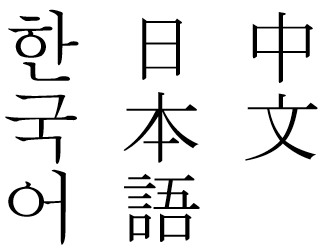

I mean, you can write in Chinese, Japanese or Korean vertically and the text remains legible they’re logographic (except Korean) so for both Chinese or Japanese: the nature of the writing system allows it for that level of flexibility when it comes to displaying text either vertically (R-L) or horizontally (L-R) while languages that use the Latin alphabet remain rigid on horizontal writing orientation only.
As in, you can display a Chinese or Japanese sentence top to bottom in vertical orientation but doing that with Latin-based languages (like English or French) makes it look crap. Today that form of writing still exists, Japanese has it in Manga where the text is formatted vertically and in Chinese it’s used for signage or pillars (Korean can be displayed in that format but it remains rare today).
With the Latin alphabet, fluent readers don’t recognize each letter individually—they recognize words and syllables based in part on the pattern of ascenders and descenders. Arranging the characters vertically disrupts that pattern.
With East Asian writing, each character represents a word or syllable, so those units don’t get disrupted by the vertical orientation.
So if you write a bunch of words with the Latin alphabet and stack them vertically as a sentence, is that a closer representation of East Asian writing?
I
guess
you
could
say
that.
B
u
ty
o
uc
a
nr
e
a
dv
e
r
t
i
c
a
l
l
ysorry lol
Sure, but you’re forced to fall back on parsing words letter-by-letter—you can’t read whole words at a glance like normal.
Many signs in English are formatted vertically. You’re imagining a problem.
I’m talking about VERTICAL TEXT via column
but doing that with Latin-based languages (like English or French) makes it look crap
Bold assumption. Who says it looks crap? Is this your “opinion” or based on a study you can share?
Why would you need to link a study to be able to say that something looks like crap?
It works fine whether or not the letters are rotated (but that does change if it goes up-to-down or down-to-up)

I have no formal basis for this, but I imagine that it has to do with kerning, the way the letters are shaped, and us just being used to reading them in a specific format. I suspect that the format is treated as ‘aesthetic’ to our brains, and breaking it annoys some small part of our brains.