

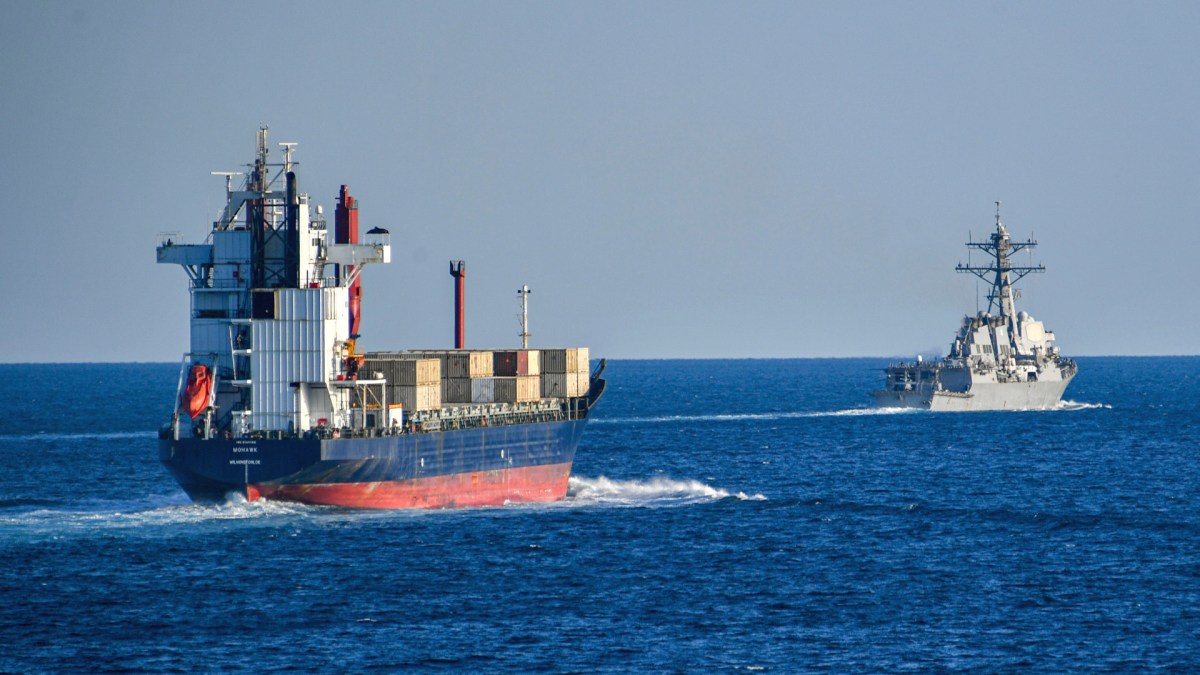
U.S. Navy could soon be escorting commercial ships through the Strait of Hormuz, where maritime traffic has effectively stopped due to the current conflict with Iran, according to President Donald Trump. Doing so would demand that American naval vessels transit through the Strait, shifting them away from other duties. More importantly, it would also mean putting them right in a super weapons engagement zone full of Iranian threats that could include cruise and ballistic missiles, one-way-attack drones, explosive-laden kamikaze boats, and naval mines.
“If necessary, the United States Navy will begin escorting tankers through the Strait of Hormuz, as soon as possible,” President Trump wrote in a post on his Truth Social social media network.
“Effective IMMEDIATELY, I have ordered the United States Development Finance Corporation (DFC) to provide, at a very reasonable price, political risk insurance and guarantees for the Financial Security of ALL Maritime Trade, especially Energy, traveling through the Gulf,” he also wrote. “This will be available to all Shipping Lines.”
“No matter what, the United States will ensure the FREE FLOW of ENERGY to the WORLD. The United States’ ECONOMIC and MILITARY MIGHT is the GREATEST ON EARTH,” he added. “More actions to come.”
U.S. Central Command declined to comment when reached for more details. TWZ has also reached out to the White House.
…
This is not the first time that the United States has been faced with this predicament or decided to start escorting commercial vessels through the region as a result. The U.S. Navy did just this in the late 1980s during the Tanker War sideshow to the Iran-Iraq War. At the same time, that experience underscores the immense amount of resources such a campaign could require, as well as the risks.
At the peak of those operations, there were some 30 American warships escorting commercial vessels to and from the Persian Gulf. Aircraft, special operations forces, and other assets were also deployed in support. The risks to American service members, as well as the ships they were tasked to safeguard, were very real.
…
Its also just obviously stupid.
It can’t possibly reliably work.
We don’t have enough interceptors to do that.
Our THAAD radar arrays that would track incoming high altitude missiles … already got taken out by Iran.
We’d have to do convoy escort formation kinda like fucking WW2, (or the more modern parellel would be the Tanker War of the 80s) and use our naval defense systems… to intercept anything incoming… which would run us out of that kind of ammo even faster…
… and also potentially just still would not work against very high altititude, very fast missiles…
… meaning that then after maybe a month or three of that, oops, we lost a fucking aircraft carrier.
Thats why nearly none of the ships have moved, despite this ‘guarantee’.
See all those clusters of red and green dots?
That’s everybody just parked in a holding pattern.
https://www.marinetraffic.com/en/ais/home/centerx:56.8/centery:25.6/zoom:8
Sal’s What’s going on with Shipping? Channel did a video that adds to your points, while covering other things that happened in between too.
We don’t have the destroyers to so this, let alone the stocks to keep them full. Last time we tried something similar with the Houthi when we stood off and bring them down along the Red Sea we ran out.
The best we might be able to do is the 5 or so US flagged vessels. Apparently France is going to do the same for their vessels. All the rest of them are probably just going to wait for the War insurance to get sorted and then start running it again (like some of them are apparently).
Good of you to link him, I watch his stuff regularly, and I guess was arguably just sort of badly summarizing / riffing off him, lol.
As the saying goes:
Ship happens.
Ship be happen’ now
I just watched his newest video and Sal’s doing it daily right now. Not much new in broad substance, but details are developing.
I went back and looked twz reported 770 missiles expended over the 9 months of their Hohthi protection. This is all missiles, so it’s unclear how much of this was offensive vs defensive, but:
So stockpiles, resupply, and production becomes a big issue, beyond the astronomical cost of this.
(All for the fucking ego of a Cheeto.)
Cheeto’s got an ego at least partially 'cuz he’s the chosen instrument of God on earth.
Holy War ain’t gonna fight itself:
https://www.msn.com/en-us/news/politics/trump-hosts-pastors-from-across-us-at-white-house-as-faith-leaders-pray-over-him/ar-AA1XCWcw
I think in the last 24 hrs, at least 5 prominent US political figures have just outright said this is a religious war, Mike Johnson, Lindsey Graham, etc.
Ya’ll Qaeda, ya’ll!