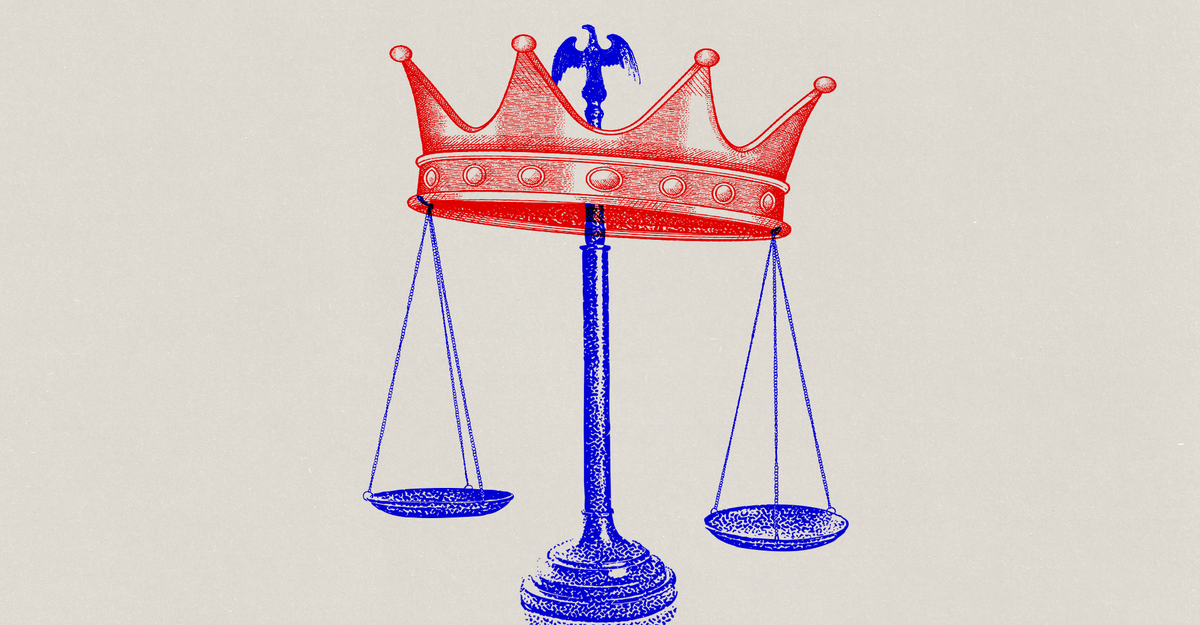
Around the world, powerful men are facing consequences for their actions. Former Brazilian President Jair Bolsonaro was convicted of trying to overthrow the government in a January 6–style coup, as was his South Korean [counterpart] (https://archive.is/o/kQAFP/https://www.cnn.com/2026/02/19/asia/south-korea-yoon-suk-yeol-verdict-insurrection-intl-hnk), Yoon Suk Yuol. Marcin Romanowski, the former deputy justice minister in the right-wing Polish government, is in hiding in Hungary, accused of misusing public funds. The former Prince Andrew—Andrew Mountbatten-Windsor—became the first member of the British royal family in several centuries to be arrested; he’s been accused of crimes related to his relationship with the late sex-trafficking financier Jeffrey Epstein.
They’re all unfortunate not to be American. Otherwise they probably would have gotten away scot-free.
Helen Lewis: The former Prince Andrew never should have forwarded those emails
One way to look at the rise of Donald Trump is as part of a decades-long backlash among the American leadership class to the idea of accountability. Since Richard Nixon was forced to resign, powerful people in both political parties have worked assiduously to ensure that their leaders would escape the consequences of their actions. Trump has evaded punishment for crimes both low (campaign-finance violations, for which he was convicted, though he will serve no time thanks to his 2024 victory) and high (his attempted overthrow of the federal government in the aftermath of his 2020 election loss, for which he was spared by the Supreme Court’s decision to grant him a kingly immunity). This is not just about Trump; his impunity is the product of a society that has worked hard to help the rich and powerful elude punishment for criminal behavior.
Gerald Ford pardoned his predecessor in the name of “healing,” but inadvertently set a precedent that executive lawbreaking was no crime. The Reagan administration engaged in blatant violations of federal law during the Iran-Contra scandal, in which it sold weapons to the Iranian regime and used the finances to support anti-communist death squads in Nicaragua. George H. W. Bush, the former head of the CIA, pardoned nearly all of the officials implicated in Iran-Contra—a move that many Americans supported, because they believed that fighting communism justified extreme measures. George W. Bush’s administration broke laws fighting the “War on Terror” but almost no one faced consequences, because many Americans believed that fighting terrorism justified extreme measures.
Bill Clinton lied under oath, was impeached, and then was acquitted—and many Americans supported that too, because they sympathized with lying about infidelity. After that, Congress decided in bipartisan fashion that it had had enough of special counsels sniffing around the executive branch. Barack Obama pledged to look forward and not backwards, not only closing the door on prosecutions for executive lawbreaking but also failing to hold accountable those responsible for the 2008 financial crisis and the ensuing Great Recession.
While Congress and the presidency have been working hard to raise the executive branch above the law, the Supreme Court has done its part to ensure that laws against bribery and corruption are near-unenforceable. With a series of rulings on campaign finance, the Roberts Court has ensured that the rich can try to buy elections without formally breaking the law. As a result, politicians are indebted to a few hundred billionaires who drop unholy amounts of cash every election cycle.
Getting convicted of bribery in America requires some serious effort—take former Democratic Senator Bob Menendez of New Jersey, who was convicted of selling influence on behalf of local businesses and the country of Egypt after being caught with gold bars in his house. When Trump first took office, he pausedenforcement of foreign bribery cases entirely—but there are some signs that he intends to revive such prosecutions as a weapon against his political enemies, in the mold of the Hungarian strongman Victor Orbán.
Such erosion of anti-corruption law has often been a bipartisan project. In 2016, the bribery conviction of former Virginia Governor Bob McDonnell for receiving gifts from donors was overturned unanimously by the U.S. Supreme Court. Since then, the Roberts Court has slowly dismantled anti-corruption law. In 2024, it decided in Snyder v. United States that federal law does not bar receiving “gratuities” given after the fact for “official acts.” Convenient not just for politicians, but also for justices who enjoy lavish lifestyles funded by billionaires with interests before the Court!
Read: The care and feeding of Supreme Court justices
The logic of the Roberts Court’s quest to legalize white-collar crime led to Trump v. United States, which decided in 2024 that the president is basically entitled to commit whatever crimes he wants in the course of his “official duties,” and which successfully shields Trump and potentially future presidents from federal criminal prosecution for any “official” actions while in office. This was comically framed by the right-wing justices as protectingdemocracy, rather than undermining it.
Although some of these decisions were more defensible than others, together they suggest a pattern of elite class solidarity: powerful people making sure that powerful people rarely face real consequences.
The #MeToo and Black Lives Matter movements can be seen as, at least partially, a brief rebellion against this culture of elite impunity. Left with few formal avenues for redress, large numbers of people demanded that the powerful—bosses and celebrities who had used their status to coerce others into sexual relationships, or police officers who had used their authority to kill without consequence—be made to pay a price for hurting others.
Those movements didn’t last. The backlash against them nevertheless fed a Trumpian nostalgia for the good old days, when sexual assault and police brutality were easily rationalized or not even discussed. This nostalgia also helps explain the extreme response to the call for accountability—many powerful bystanders behaved as though they had narrowly survived Robespierre and the guillotine and worked to prevent such movements from ever emerging again by trying to censor speech associated with them. An echo of that earlier outrage followed the revelations of the Epstein files, though this round has so far been diverted into mutual partisan recrimination, more than the focus on institutional changes that characterized those earlier movements.
This is not to say that the rich and powerful are never held to account. Menendez is one counterexample, and Epstein himself was a billionaire who died in a jail cell, after all. But his crimes were taken seriously by authorities only after the journalist Julie Brown uncovered the extent of Epstein’s crimesand the lenient response from law enforcement over decades.
Unfortunately, many Americans who might have been outraged at this edifice of impunity have instead directed their resentment toward the poor and weak, supporting a cruel and unforgiving system of criminal justice that harshly punishes those at the bottom of the socioeconomic ladder while exempting many at the top from any accountability at all. So you did a few death-squad massacres or wedding bombings? Well, that was what America’s leaders had to do to fight communism and terrorism. You can even take a sack of cash from an undercover FBI agent if you’re the Trump immigration czar Tom Homan. But if you overstayed your visa or got an abortion, you deserve to have the book thrown at you.
Trump himself can be seen as benefiting from a backlash against accountability in the last place powerful people in America seem to face it: the court of public opinion. Trump, and other powerful figures, made the public an offer: Let us get away with what we want to do, and you will too.
“They voted for impunity for themselves and authoritarian brutality directed at everyone they hated. Lesbian feminist bitches, dirty job-stealing immigrants, evil perverted trannies, on and on and on,” Katherine Alejandra Cross writes of Trump’s implicit bargain in Liberal Currents. “The brutality of state violence was supposed to only ever be directed at their ideological foes. And in exchange, the Trump voter would never again have to live with the mortifying ordeal of responsibility.”
MAGA also offered an implicit bargain: Not only can you be a bigot toward whatever group makes you mad by existing, but everyone will have to love and respect you anyway. This was an impossible promise to keep—not even Trump has managed to bully comedians mocking him into silence—but politicians make impossible promises all the time. Many Americans are simply content to live vicariously through Trump’s impunity, even if they cannot share it.
I don’t want to overstate the case that America is unique in its embrace of elite impunity. Brazil and South Korea are arguably outliers in their commitment to defending the integrity of their democracy against the corruption of the wealthy and powerful. But they also don’t hold themselves out as the indispensable nation, the shining city on the hill, the model to which all other democracies should aspire.
The answer to why powerful people in some other parts of the world face consequences, while in America they rarely do, is that elite impunity is now an American national project. We might need to reframe “American exceptionalism.” Instead of a New Deal, we have a Great Society for white-collar crime, a New Frontier of executive lawbreaking, a No Rich Crook Left Behind. Most of us probably don’t even realize it. Nevertheless, this has been the priority for the wealthy and powerful, who have managed to convince a critical mass of Americans that they will be able to enjoy the same privileges. They won’t.
Because money buys you control over the legislature, law enforcement, and the court system. This is not a complicated concept. We may not have nobility but we’re full blown oligarchy now.
Voters by and large first concern themselves with who did what and which letter is beside their name, R or D, to decide if it’s ok or bad. Democrats refuse to hold their people accountable until way after the fact, with Republicans doing the same thing.
The whole ‘lesser evil’ bullshit gave us incremental fascism.
What’s this “we” stuff, subby? I totally hold the Trump administration responsible for their crimes and if there was a button that would make the top 200 member’s heads detonate in a Scanners-style explosion, well you could consider that button pushed.
While ignoring Dem complicity… Our current situation didn’t happen in a vacuum. It had help