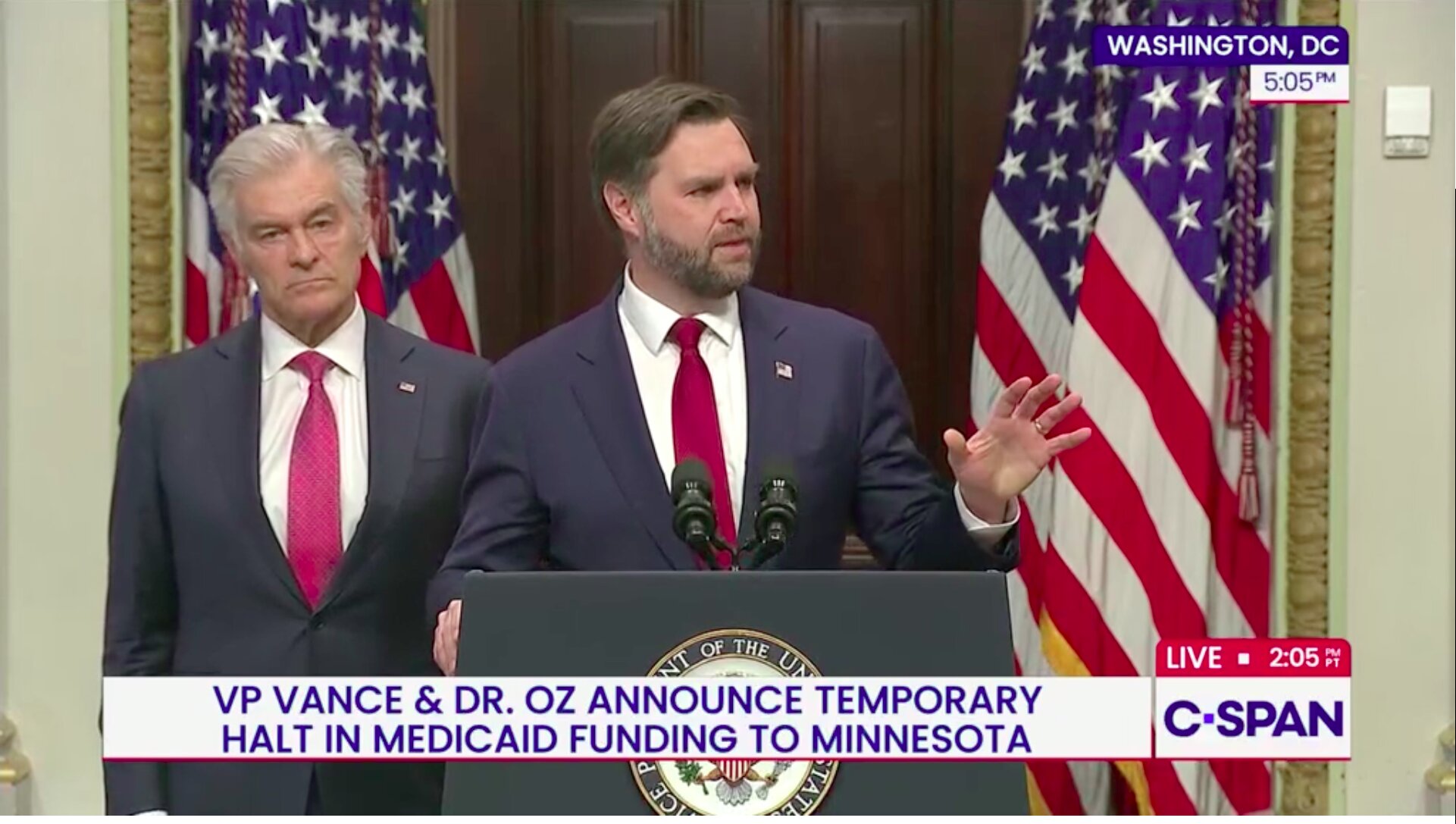
Vice President JD Vance announced on Wednesday that the Trump administration would "temporarily halt" over $200 million in Medicare funds for Minnesota in an effort to address fraud in the state.
It’s a great idea, but the problem is people file their federal taxes as individuals and pay the IRS directly, so how are the blue states supposed to withhold the money?
Most people don’t pay their taxes directly; they are withheld from their paycheck by their employer. State and local governments are employers; they withhold taxes from their employees. They can report that they have withheld those taxes from the taxpayers, but transfer those taxes to the state treasury instead of the IRS.
The state could create a jobs placement program that operates like a temp agency. Workers participating in the program are employees of the state, not the business they are contracted to.
The federal government will hold the taxpayer responsible for not paying their federal taxes. The employers withholding federal taxes from paychecks and not forwarding that on to the IRS would be committing a federal crime, but the IRS would still demand their tax payment from each taxpayer, just like how it happens if the employer didn’t withhold enough–the taxpayer has to send in a check.
That’s just how the system and law works. Federal law supersedes State law. You pay federal taxes to the federal government under federal tax laws, and the State has no power to say you don’t owe them.
The taxpayer is paying their federal taxes. The money is being withheld on their behalf. They are receiving a W2 stating their earnings and withholding. Their employer is properly filing, but they are not sending the money they claim to owe.
If your employer does all this, the IRS can’t blame you for not paying your taxes. You have proof that you did. The IRS can’t sue all of the company’s employees for the company’s failure to pay. They have to go after the company, not you.
They could even do it legally. If the state won a case saying the federal government illegally withheld Medicaid funds from the state and its citizens, the state could get an order to seize federal assets, including employee withholding from state workers.
Thanks, it’s good to know that it wouldn’t fall on the employee. I looked it up[1] and you’re right – if your employer withheld the money and you can prove it (either via the W2, or by producing your paycheck stubs showing the amounts withheld if there’s no W2), then the Feds will go after the employer, not the employee.
I also learned that if your employer didn’t pay the feds and/or give you or the Feds a W2, then it falls on you to prove they withheld money by showing the IRS your paycheck stubs (or by managing to get that info from the employer), otherwise you will still have to pay the taxes. So the lesson there is to save your paycheck stubs (or electronic copies thereof), especially the last one of the year showing the totals, just in case!
So, back on the topic of States trying to keep that money from going to the Feds, my previous argument would still apply, except that the employers would be held liable by the Feds instead of the individual employees, under current laws (AFAIK!). So if the State passed a law saying the companies have to give that money to them instead of the IRS, the companies would be in a catch-22 situation of Fed law saying Feds get it and State law saying the State gets it. So again, Fed law would supersede the State law and companies would have to give the money to the Feds.
Do you know a way the States could get around that issue? It would be great if they could but I don’t see how.
They can’t get around it for private employers, but state and local governments are employers and perform withholding.
The state could also enact a job placement program, and function as a temp agency: the worker is the employee of the temp agency, not the client company they are contracted to.
Those are good ideas, though the court costs of fighting Fed lawsuits might outweigh the amount garnered. And/or the Feds would retaliate by withholding other fed money owed to the state (like it’s already doing in some cases! Like the medicaid money for Minnesota, etc).


It’s a great idea, but the problem is people file their federal taxes as individuals and pay the IRS directly, so how are the blue states supposed to withhold the money?
Most people don’t pay their taxes directly; they are withheld from their paycheck by their employer. State and local governments are employers; they withhold taxes from their employees. They can report that they have withheld those taxes from the taxpayers, but transfer those taxes to the state treasury instead of the IRS.
The state could create a jobs placement program that operates like a temp agency. Workers participating in the program are employees of the state, not the business they are contracted to.
See my answer to glitch1985. I meant to put it here but accidentally clicked reply on their post instead.
Wouldn’t be all of it but the state could instruct any businesses in the state to not submit any federal tax it collects
The federal government will hold the taxpayer responsible for not paying their federal taxes. The employers withholding federal taxes from paychecks and not forwarding that on to the IRS would be committing a federal crime, but the IRS would still demand their tax payment from each taxpayer, just like how it happens if the employer didn’t withhold enough–the taxpayer has to send in a check.
That’s just how the system and law works. Federal law supersedes State law. You pay federal taxes to the federal government under federal tax laws, and the State has no power to say you don’t owe them.
The taxpayer is paying their federal taxes. The money is being withheld on their behalf. They are receiving a W2 stating their earnings and withholding. Their employer is properly filing, but they are not sending the money they claim to owe.
If your employer does all this, the IRS can’t blame you for not paying your taxes. You have proof that you did. The IRS can’t sue all of the company’s employees for the company’s failure to pay. They have to go after the company, not you.
They could even do it legally. If the state won a case saying the federal government illegally withheld Medicaid funds from the state and its citizens, the state could get an order to seize federal assets, including employee withholding from state workers.
Thanks, it’s good to know that it wouldn’t fall on the employee. I looked it up[1] and you’re right – if your employer withheld the money and you can prove it (either via the W2, or by producing your paycheck stubs showing the amounts withheld if there’s no W2), then the Feds will go after the employer, not the employee.
I also learned that if your employer didn’t pay the feds and/or give you or the Feds a W2, then it falls on you to prove they withheld money by showing the IRS your paycheck stubs (or by managing to get that info from the employer), otherwise you will still have to pay the taxes. So the lesson there is to save your paycheck stubs (or electronic copies thereof), especially the last one of the year showing the totals, just in case!
So, back on the topic of States trying to keep that money from going to the Feds, my previous argument would still apply, except that the employers would be held liable by the Feds instead of the individual employees, under current laws (AFAIK!). So if the State passed a law saying the companies have to give that money to them instead of the IRS, the companies would be in a catch-22 situation of Fed law saying Feds get it and State law saying the State gets it. So again, Fed law would supersede the State law and companies would have to give the money to the Feds.
Do you know a way the States could get around that issue? It would be great if they could but I don’t see how.
[1] https://www.taxaudit.com/tax-audit-blog/2025/what-happens-if-my-employer-doesn-t-pay-my-payroll-taxes
They can’t get around it for private employers, but state and local governments are employers and perform withholding.
The state could also enact a job placement program, and function as a temp agency: the worker is the employee of the temp agency, not the client company they are contracted to.
Those are good ideas, though the court costs of fighting Fed lawsuits might outweigh the amount garnered. And/or the Feds would retaliate by withholding other fed money owed to the state (like it’s already doing in some cases! Like the medicaid money for Minnesota, etc).