

- cross-posted to:
- [email protected]
- cross-posted to:
- [email protected]
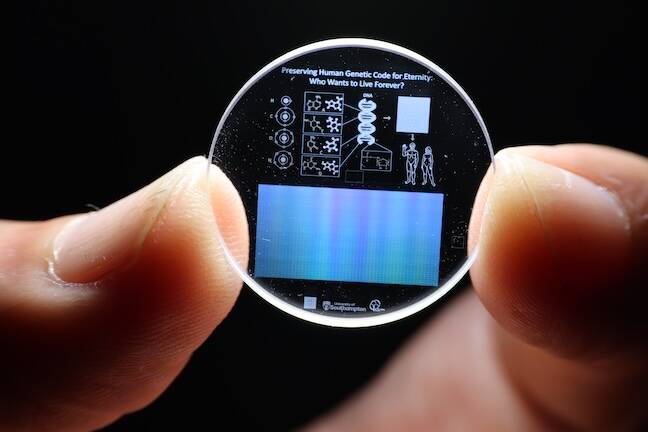
“the medium is silica crystal, similar to optical cable, it’s highly durable. It’s also capacious: The technology can store up to 360 TB of data on a 5-inch glass platter.”
“the medium is silica crystal, similar to optical cable, it’s highly durable. It’s also capacious: The technology can store up to 360 TB of data on a 5-inch glass platter.”
The degradation of materials is pretty well understood. If it’s truly cut from a well known material with zero factors that could effect that degradation, it’s mostly safe to make en educated wish.
I’ll have to remember this
“zero factors that could effect that degradation”
So in other words, only a completely unrealistic estimate can be made? After all, our sun is not going to be the same in 5 billion years, so unless the material comes along with a solution to maintain the material’s temperature (as per the manufacturer’s website the longevity is temperature-dependent) then 14 billion years sounds rather unlikely.
You don’t take into account external factors like that. This is like saying “oh your watch battery will last an entire year? What about if I launch it into the sun‽‽”
Honda won’t honor my 10-year powertrain warranty just because I yeeted my 2-year-old Civic off a bridge into salt water!
You can put it on a spacecraft, and fling it at a bunch of star systems. Also preserving knowledge is still one of our hardest topic to solve. After the resources wars, what will computing even look like? Will we even make it another 3k years? How will we warn the next inhabitants of our pitfalls? Surely anything containing rubber gaskets will be ruined, all capacitors will have leaked. Any iron will have rusted.
I don’t think the point is that you can sue them if it only lasts 13 billion years, but the under current conditions it’s projected lifetime is 14 billion years. Which is a very big number, meaning it’s pretty much guaranteed it won’t break in 100, 1000 or 10000 years.