
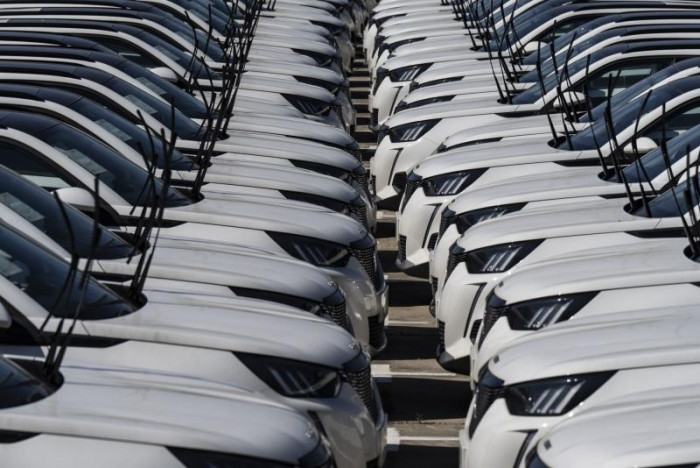
- China’s industry had built capacity for 20 million EVs and plug-in hybrids annually but remained saddled with enough factories for 30 million gasoline vehicles
- Fossil-fuel vehicles accounted for 76% of China’s auto exports since 2020 with annual shipments jumped from 1 million to likely >6.5 million in 2025
China’s electric vehicle (EV) industry captured half its domestic market in just a few years, crushing sales of gasoline-powered vehicles from once-dominant global automakers.
But foreign players were not the only losers. Many Chinese legacy automakers also watched their sales collapse – and responded by flooding the world with fossil-fuel vehicles they could not sell at home.
While Western policymakers have focused on the threat of China’s heavily subsidised EVs, protecting their markets with tariffs, US and European automakers face greater competition from China’s gas-guzzlers in countries from Poland to South Africa to Uruguay. Fossil-fuel vehicles have accounted for 76% of Chinese auto exports since 2020, and total annual shipments jumped from 1 million to likely more than 6.5 million this year, according to data from China-based consultancy Automobility.
…
The boom in China’s gasoline-powered exports is driven by the same EV subsidies and policies that wrecked the China businesses of automakers including Volkswagen, General Motors (GM) and Nissan by underwriting scores of Chinese EV makers and igniting a devastating price war, a Reuters examination found. The phenomenon highlights the far-reaching impacts of Chinese industrial policy, as foreign competitors struggle to keep pace with government-backed firms chasing Beijing’s goals to dominate critical sectors nationally and globally.
…
China’s gasoline-vehicle exports alone – not including EVs and plug-in hybrids – were enough last year to make it the world’s largest auto-exporting nation by volume, industry and government data show.
…
Chinese carmaker SAIC’s exports – mostly of its own brands, without [former joint venture partner] GM – soared from nearly 400,000 annually in 2020 to more than a million last year.
Dongfeng’s exports of nearly 250,000 vehicles last year, up almost four-fold in five years, proved critical as sales of its China partnerships with Honda and Nissan entered a “downward spiral,” said Jelte Vernooij, Dongfeng’s Central Europe manager.
Dongfeng’s annual global sales have fallen by a million vehicles since 2020, to less than 2 million, company filings show. Yet Vernooij is not worried about Dongfeng’s future – because it has Beijing’s backing.
“The fact that we’re state-owned is key,” he said. “There’s no question that we will survive.”
…
China’s top auto exporter is Chery, whose global sales rocketed from 730,000 vehicles to 2.6 million between 2020 and 2024. Chery, which has both state and private owners, grew annual exports over the period by about a million units – relying mostly on the gasoline-powered vehicles that comprise four-fifths of its sales. China’s top 10 exporters include five other state-owned automakers and two private ones, Geely and Great Wall Motor (GWM), that also sell more gasoline vehicles than EVs.
…
Only two of China’s top 10 auto exporters focus exclusively on battery-powered vehicles. One of them is US electric-car pioneer Tesla. The other is BYD, which sells only EVs and plug-in hybrids.
…
Chinese automakers’ rush to export gasoline cars can be traced to government policies that created a glut of factory capacity to build them.
China’s rapid EV growth idled assembly lines capable of producing up to 20 million gasoline-powered cars annually, estimates Automobility CEO Bill Russo. Such unproductive overhead raises costs, pressuring automakers to repurpose capacity for exports.
…
[Chinese] automakers got cheap EV factories financed by [Chinese] cities and provinces eager to demonstrate development.
“Local governments even prepare the land and build the factories, allowing companies to 'move in with just a suitcase,'” said Liang Linhe, chairman of Sany Heavy Truck, among China’s largest truck makers.
The result: massive overcapacity. At a March EV conference, Su Bo, China’s former vice minister of industry, urged regulators to promote the conversion of gasoline-car factories to build battery-powered models. He estimated China’s industry had built capacity for 20 million EVs and plug-in hybrids annually but remained saddled with enough factories for 30 million gasoline vehicles – far more than its domestic market needs.
…
 11·1 day ago