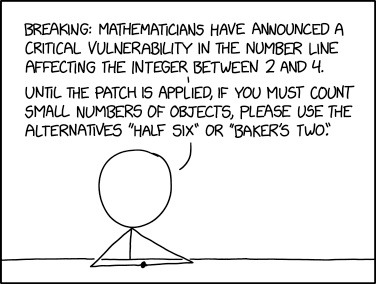
Title text:
Other numbers are largely unaffected, but anyone using ‘4’ for their certificate key is urged to upgrade to ‘5’.
Transcript:
Transcript will show once it’s been added to explainxkcd.com
Source: https://xkcd.com/3314/
I’ve slowly learned in life that every system, every design we rely on was thought up by other humans a LONG time ago, never updated or replaced with something new, and is within inches of crashing and burning at any single second.
If you think I’m crazy (don’t worry, I most certainly do) spend a calm afternoon examining the support columns of your local bridges.“Half six” is fraught with peril. One slight misunderstanding and you’ll have Germans and Dutch at your door when you least expect it and a bunch more people an hour later.
And the Danes will think you’re talking about 50

*Puts on glasses* Akchually, that’s only if you’re counting 10’s, since we count 1’s as decimal and 10’s in pairs of snes/snaes (20), hence fifty is half three snes or
3*20-0.5*20 = (3-0.5)*20 = 50.Or if you’re talking 1’s, aka. decimal, you’d just remove the snes part, since common math is in decimal anyway, so half 3 decimal would be
3*1-0.5*1 = 3-0.5 = 2.5.EDIT: Fun fact: 100, aka. “en hundrede/one hundred”, can therefore also be called “fems” or “fem snes/five snaes”. And then there’s the ones who actually say “in twenty” instead of “snes”, so it’d be “fem i tyvende”.
But you never said which game on the SNES these cheat codes actually for.
Oh no, no game, that’s how you enable the dev tools in retro-future mode. :p
That’s only partly correct.
Write out the name for 50 and it becomes “halv tre sinds tyve”, where “sinds” is a old word for multiply. Thus making a complete translation “half three times twenty” https://sproget.dk/sprogviden/spoergsmaal-og-svar/dansk-sprognaevn/sv00000047/
Huh? TIL. Well, partly. Didn’t actively know about the “sinds”.
So, does this mean that “snes” is just a load of bull, or are we talking different ages of counting systems? After all, just like the link explains “fyrre”, the Danish counting system seems as an amalgamation of multiple counting systems and words of the time.
What is the origin of this system? It’s nuts.
It’s just pre-imperial. We’ve left everything else behind for metric, but the snaes still roams the shadows of our counting system.
Everyone knew what a snaes was and everyone measured in snaes enyway, it also happened to be about the amount that we stored fish and eggs as. So, instead of having to count all the fish, we simply asked for one snaes/box of fish. And if you needed 2,5 snaes of fish? well, then you simply asked for half three snaes.
For a very interesting example of modern culture using such improvised counting systems, look no further than the USA’s obsession with measuring everything in football fields, elephants, etc…
And for an example for saying “half x”? Ask anyone who has ever said “let’s meet at half six”.
Det ved jeg godt :)
But it’s fun to show that meme off. Danish numbers are wild. My bad danish gets me mistaken numbers all the time
Tænkte det nok x)
It’s just fun to blow some non-Danes’ minds every now and again. <3
Every time we take the ferry to get drunk our minds are blown by fem og halv treds
I would really like to understand more, why do you simplify 320-0.520 as (3-0.5)*20? Is this system actually insightful into arithmetic? Is there a good tutorial about such and such?
Well, it is just arithmetics.
The left side of the equation is just the natural expansion of the paranthesis to signify and drive home the point that we’re specifically talking half off 20.
The middle is how it’s usually represented and follows best practices. Aka. Simplifying the equation without touching the variables and constants.
The right side is the result for calculating the equation.
I’m unsure of any tutorials regarding the danish counting system, though there’s bound to be some. :)
Did I misunderstand the question?
puts on novelty slinky eye glasses
Fascinating.
Also, small thing:
3*1 - 0.5*1 = 3 - 0.5 = 2.5----------------^Nice spot ,’ Seems not even a Dane is danish enough to Dane.
Can confirm this caused a lot of confusion for the 6 months i lived in the uk as a dutch person lol. Eventually we just ended up saying the numbers.
The explainXKCD being down for this is kinda hilarious
explainXKCD runs on MediaWiki which is PHP, so yeah…
I’m glad I learned about this. I was about to make a private key with the number 5. Now I will make it with half 6 knowing that it’s more secure, and backed by science!
I heard encryption is based on prime numbers. You might want to try 7.

Nah man, 5 is right out.
I prefer Quarter Dozen
In England, “half six” would mean the same as “half past six” aka 6:30.
And I’ve been doing this for years: If I “accidentally” get into the 10 items or fewer line with 11 items, I just tell myself it’s a “baker’s 10.” And, of course, 12 items is a “baker’s baker’s 10,” as we have no other name for 12.
Reinventing church numerals as a rationalisation for grocery checkout hijinks - I absolutely love this.
Isn’t this Peano numerals? Church numerals would be if a baker’s four doubled two was sixty-four.
(That being (λf. λx. f (f (f (f (f x))))) (λn. λf. λx. n f (n f x)) (λf. λx. f (f x)))
Would they not be equivalent systems for this purpose? Both use the successor function as a unary representation of the natural numbers.
Yes, Church numerals are something more specific. Church numerals are a model of Peano arithmetic, I think. So basically all Chuch is Peano but not all Peano is Church.
Ohhh, I see what’s happened!
Okay so, in this case you could make an argument that these aren’t Peano numbers because this isn’t an operation involving the set of all natural numbers (as in this hypothetical we’re starting from 10, not 0) nor are they church numerals (as a term for a unary representation) for the same reason (and also they aren’t for the other use of church numeral as the count of repeated composition [edit: and I will yoink that sidetrack ramble. bad warl0k3]), but I’m not going to do that because fuck me would that be a sign of near-terminal grass deficiency. Anyway, the above method of rationalizing grocery crimes is an example of what in computer science is generally called a church numeral, but only when working within a context that assumes base-10 representations of values are a shorthand for a unary representation of values. Whereas what generally gets called ‘Peano numbers’ are a purely unary expression of the natural numbers, but does not need the additional context to specify their use in this manner. I was assuming that compsci context, which I realize now that I shouldn’t have been doing
Thank you, this was interesting and something I really should have been more aware of!
I guess if I say that 1 is baker’s 0, and 2 is baker’s baker’s 0, then I’ve invented the baker’s unary base.
Gaben likes this https://youtu.be/8leRDCs2NpM?t=76
Alt text going hard
XKCD spitting fire
Heh, reminds me of my national counting system where “halv seks” would mean 5,5. Aka. half before six, and not half of six. :P